Every musician has a story. Some stories are celebrated on grand stages, while others remain quietly tucked away in memories, waiting to be told.
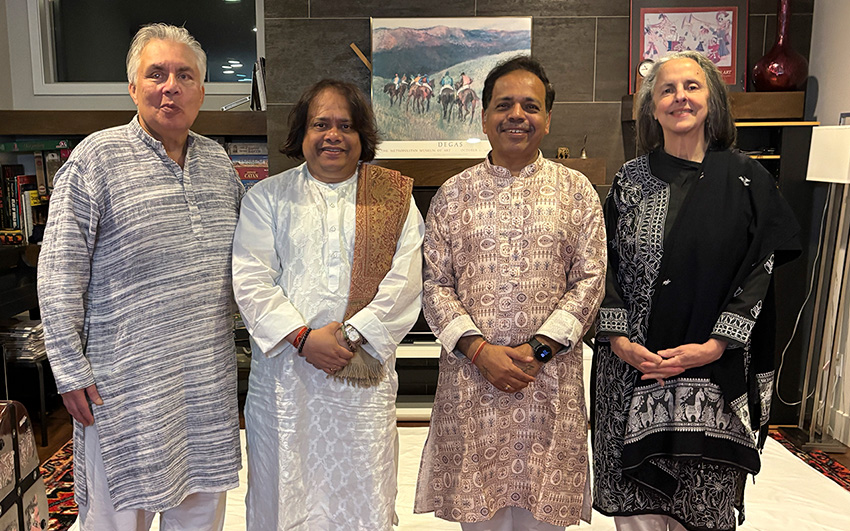
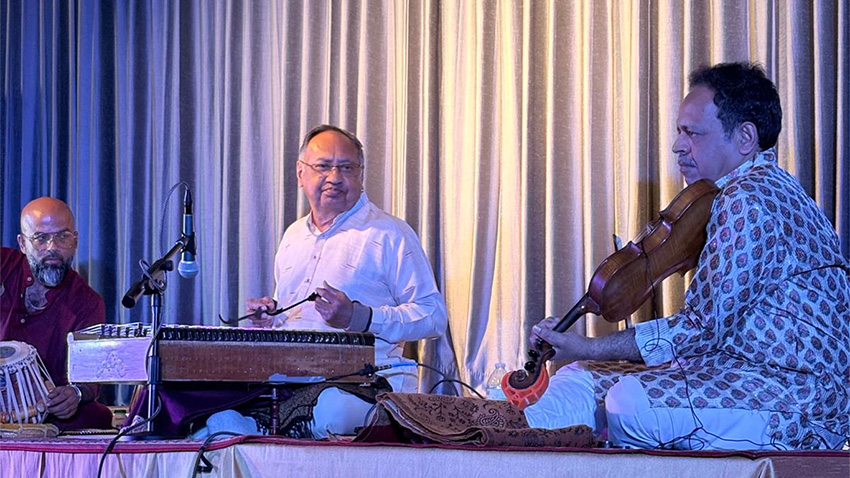
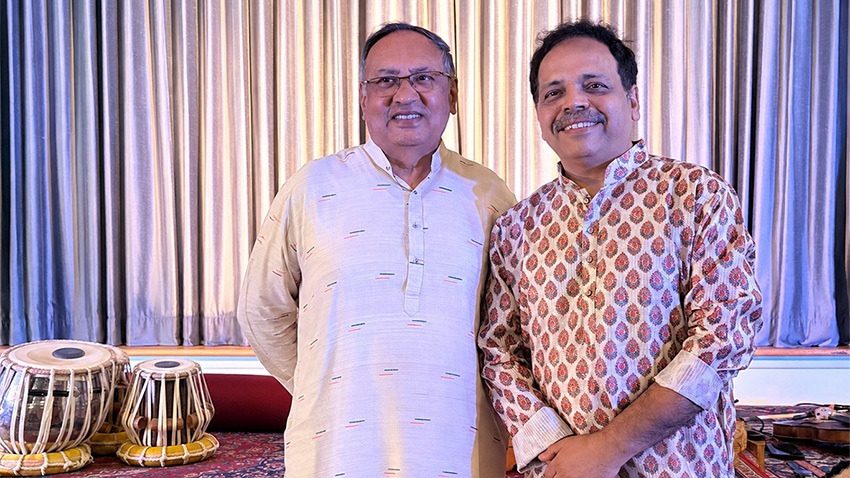
 During my recent concert tour of North America, I had the pleasure of spending time with renowned Santoor maestro Pt. Nandkishore Mulay, the first disciple of the legendary Padma Vibhushan Pt. Shivkumar Sharma Ji.
We had just performed a memorable jugalbandi in Orlando, Florida, presenting Raga Jansammohini, accompanied by the accomplished tabla maestro Pt. Shankh Lahiri.
The following day, sitting comfortably at his residence in Orlando, our conversation travelled back several decades — to Baroda, Mumbai and Germany, and to a young boy whose fascination with an unfamiliar musical instrument would eventually shape his entire life.
What unfolded was not merely the story of a musician. It was a fascinating account of curiosity, determination, ingenuity and extraordinary devotion to music.
A Sound That Changed Everything
The story begins around 1967–68.
A young Nandkishore Mulay, barely thirteen or fourteen years old, attended a music festival in Baroda where Pt. Shivkumar Sharma was performing.
The Santoor was still a relatively unfamiliar instrument to many music lovers. For young Nandkishore, it was something entirely new.
He remembers sitting quietly in the green room, watching Shivji prepare his instrument. He carefully observed how the maestro held the wooden strikers, tuned the strings and positioned himself to play.
And then came the sound.
The moment Shivji played a few notes, something stirred within the young boy.
He was captivated by the instrument’s distinctive tonal beauty.
As he recalled during our conversation, he had already begun mentally visualising the entire process of playing the Santoor.
That brief encounter planted a seed that would grow into a lifelong musical pursuit.
When Two Spoons Became Santoor Strikers!
This was perhaps one of the most delightful revelations of our conversation.
Having returned home, young Nandkishore was determined to recreate the sound he had heard.
But there was a problem.
He did not own a Santoor!
Fortunately, he came from a musical family. His father was a musician and taught vocal music at the Music College in Baroda. Musical instruments were therefore not unfamiliar objects in the Mulay household.
Among them was a swaramandal.
The young boy tuned the swaramandal to a raga, picked up two ordinary spoons from the kitchen and began striking its strings, attempting to reproduce the Santoor technique he had observed.
Imagine that!
A future Santoor maestro beginning his journey with a swaramandal and two kitchen spoons!
There was no YouTube, no online tutorial and no readily available demonstration video.
Only observation, memory, imagination and an irresistible desire to learn.
To me, this little episode beautifully illustrates something fundamental about great musicians: their musical journey often begins long before formal training, driven by an inner curiosity that refuses to remain silent.
A Santoor That Was Waiting to Be Played
The next challenge was finding an actual Santoor.
In those days, acquiring the instrument was no simple matter. Santoors were associated with Kashmir and were not commonly available in Baroda.
A fortunate coincidence eventually changed everything.
Through an acquaintance connected with his father’s music college, Nandkishore learned about a gentleman named Hasmukhbhai Patel, who owned a Santoor.
Mr. Patel had apparently purchased the instrument during a visit to Kashmir. However, he did not know how to play it, and the Santoor had remained largely unused at his residence.
Interestingly, Mr. Patel had also been associated with Nandkishore’s father as a music student.
When the young aspiring musician approached him, the connection helped open the door.
Nandkishore eventually acquired his first Santoor for a modest sum that he recalls as approximately ₹250.
The instrument may not have been new, but for him, it represented the beginning of an extraordinary dream.
Even tuning it was an adventure!
He remembers spending nearly one and a half to two hours tuning the strings. By the time the instrument was ready, he would sometimes be so exhausted that he needed a short nap before beginning his practice.
And yet, he persisted.
Remarkably, he told me that he still possesses the original wooden strikers that came with that first Santoor.
What a beautiful connection to one’s musical beginnings!
From Baroda to Mumbai: In Search of a Guru
By the early 1970s, Nandkishore’s determination had become stronger.
He wanted to learn from none other than Pt. Shivkumar Sharma himself.
But approaching a maestro of Shivji’s stature was not easy.
After completing his bachelor’s studies, he expressed his desire to travel to Mumbai and meet the legendary Santoor exponent.
An introductory letter was arranged, but the initial attempt did not produce the desired result.
Did he give up?
Certainly not.
For nearly two years, he continued travelling from Baroda to Mumbai during vacations.
He would scan newspapers to discover where Shivji was performing, attend those concerts and make himself available to help carry the Santoor or assist with arrangements.
He was not looking for recognition or a place on the stage.
He simply wanted an opportunity to learn.
Eventually, Shivji noticed the young man who kept appearing at his concerts.
During one such encounter, the maestro asked him what he was doing.
Nandkishore explained that he had come from Baroda because he wanted to learn the Santoor from him.
When Shivji discovered that he already possessed an instrument and had been practising through observation, he invited him to bring the Santoor and demonstrate what he knew.
Nandkishore remembers playing Raga Yaman.
Shivji then began explaining the technical foundations of the instrument and how he should approach his riyaz.
That was the beginning of a remarkable Guru–Shishya relationship.
What fascinates me about this episode is the extraordinary patience of a young musician who pursued his Guru not through convenience, but through unwavering commitment.
Sometimes, the first lesson in music is not a raga or a composition. It is perseverance.
Germany: From Struggling Musician to a Home for Musical Legends
Our conversation also touched upon another fascinating chapter of his journey — his early days in Germany.
Like many Indian musicians who travelled abroad during those decades, Nandkishore faced unfamiliar surroundings and financial challenges.
He recalled receiving support from German acquaintances and a few Bengali friends who were enthusiastic about Indian music.
While living in Hamburg, he decided to put up a notice offering lessons in Indian music. Those were the days when even a small teaching fee, collected in German marks, could make a meaningful difference.
Gradually, students began approaching him, and music became a means of supporting himself in a foreign country.
But what began as a struggle for survival eventually evolved into something far more significant.
His home in Germany became a welcoming destination for some of the greatest legends of Indian classical music.
As he shared, maestros such as Pt. Jasraj, Pt. V. G. Jog, Pt. Hariprasad Chaurasia, Ustad Zakir Hussain and his own Guru, Pt. Shivkumar Sharma, along with numerous other distinguished musicians, would stay at his residence during their concert visits to Germany and other parts of Europe.
Imagine the musical atmosphere of that home!
A place where legendary musicians could find not only hospitality but also the warmth of a fellow artist who understood their music, their journeys and their needs.
What makes this story particularly touching is that the young musician who had once struggled to establish himself in a foreign country eventually became a friend, host and source of support to some of India’s most celebrated musical personalities.
His contribution was therefore not confined to performing or teaching the Santoor. Through his personal relationships and hospitality, he also helped sustain the cultural connections that brought Indian classical music closer to European audiences.
I find this aspect of his journey especially meaningful.
The history of Indian classical music abroad has not been shaped by great performers alone. It has also been shaped by individuals who opened their homes, shared their resources and quietly created an ecosystem in which music could flourish.
Pt. Nandkishore Mulay represents that remarkable tradition.
And perhaps this is one of the most beautiful revelations of our conversation: behind a distinguished Santoor maestro stands a generous human being whose home became a meeting place for musical greatness.
Beyond the Maestro, the Human Being
Having spent several decades in the world of classical music myself, I have come to believe that the most inspiring stories are not always about awards, prestigious concerts or public recognition.
They are often about the unseen years.
The years of struggle.
The unexpected encounters.
The small acts of kindness.
And the determination to continue despite seemingly impossible circumstances.
Listening to Pt. Nandkishore Mulay, I was reminded that behind every accomplished musician is a young student who once struggled to acquire an instrument, find a Guru or simply create an opportunity to learn.
What makes his journey particularly inspiring is the combination of an extraordinary musical lineage and an intensely personal struggle to pursue that lineage.
The boy who once used kitchen spoons to imitate Santoor strikers eventually became a disciple of the very maestro whose music had first captivated him.
Life, sometimes, composes its own beautiful bandish.
The Music Behind the Music
Our Orlando jugalbandi was a delightful musical experience. But the conversation that followed gave me an opportunity to discover another dimension of the artist with whom I had shared the stage.
And that, to me, is the real spirit of Classical GupShup.
To travel beyond the concert platform.
To discover the untold stories behind familiar names.
To celebrate the individuals whose dedication, imagination and sacrifices have contributed to the extraordinary heritage of Indian classical music.
As I left that conversation, one image remained particularly vivid in my mind.
A thirteen-year-old boy in Baroda, sitting before a swaramandal, holding two kitchen spoons and dreaming of the Santoor.
Who could have imagined where those first tentative notes would take him?
Perhaps every great musical journey begins not with an instrument, but with an irresistible desire to create music.