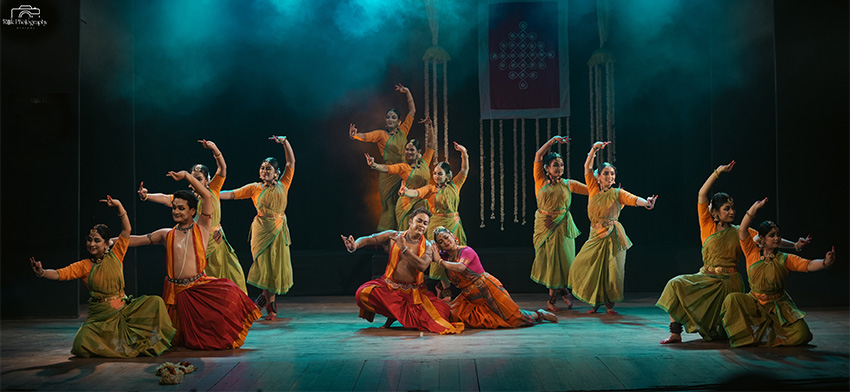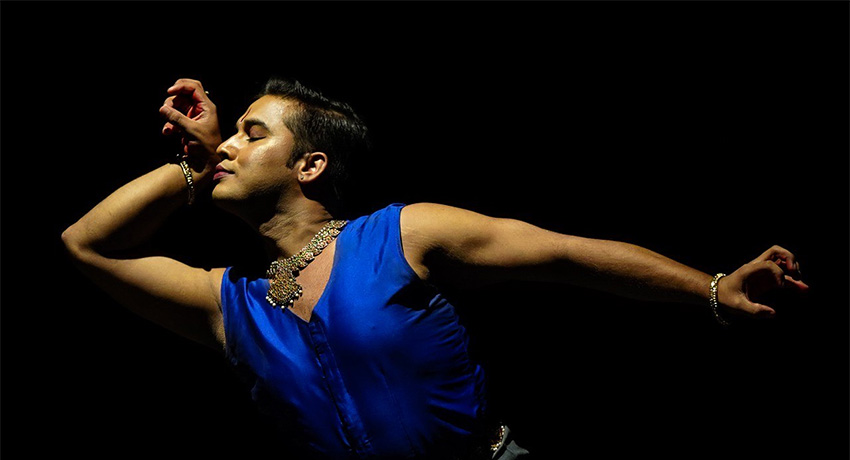
Bharatanatyam dancer and choreographer Vinay Tiwari is exploring an unusual artistic question: can the vocabulary of a South Indian classical dance form become a medium for Bhojpuri language, memory and lived experience?
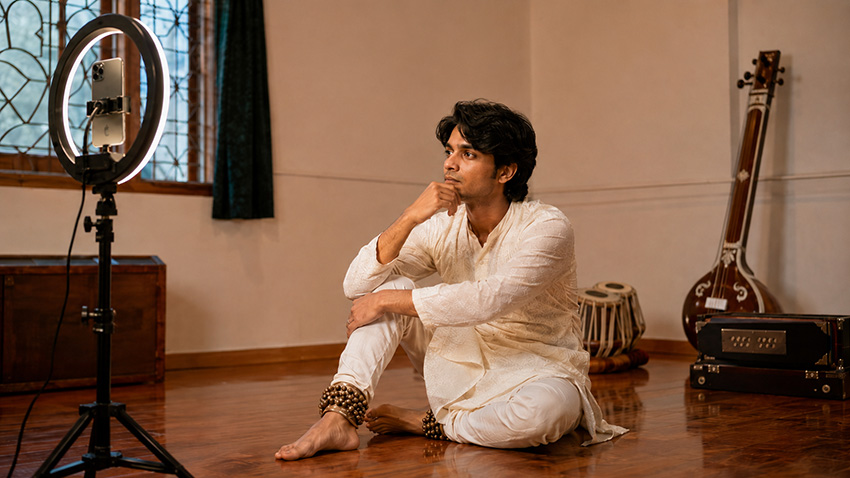
Trained under Vidushi Rama Vaidyanathan, Vinay is a Bharatanatyam dancer, podcaster, TEDx speaker, and emerging choreographer. Hailing from Salempur in eastern Uttar Pradesh, he is committed to bringing Bhojpuri language, culture, and traditions into the world of Indian classical dance. His debut solo production, Abhadra, reflects his unique artistic vision and explores the cultural identity of the Bhojpuri-speaking community through Bharatanatyam.
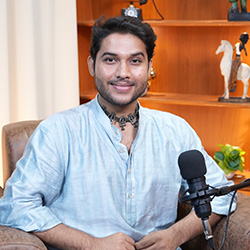
Recalling his early years, Vinay says, “I come from Salempur, a small town in eastern Uttar Pradesh. During my school days, I was introduced to Indian dance forms and developed a keen interest in dance. At that time, I did not even know the difference between Bharatanatyam and other classical forms; I simply knew that I wanted to dance.” His journey eventually led him to Bhatkhande Music University, where he completed his Diploma in Bharatanatyam and also earned a diploma in Indian folk dance.
“I often say, ‘I didn’t choose Bharatanatyam; Bharatanatyam chose me.’ During my university audition, I was actually performing more gymnastics and contemporary movements!” he recalls. Coming from a family associated with education, with his mother serving as a government junior high school principal, Vinay also pursued academics alongside his artistic journey, completing master’s degrees in Sociology and later in Bharatanatyam.
A turning point came when, while pursuing his senior diploma, he had the opportunity to watch Padma Bhushan Dr. Saroja Vaidyanathan and Sangeet Natak Akademi Awardee Vidushi Rama Vaidyanathan perform. “That experience changed my life and made me realise that I truly wanted to become a dancer,” he says. After completing his diploma, Vinay worked at Delhi Public School, Lucknow, but eventually decided to follow his calling. “I quit my job, packed my bags, and moved to Delhi. I have now been living here for eight years, training under my gurus and continuing my learning and guidance under Vidushi Rama Vaidyanathan ji.”
His background in Sociology has also deeply influenced his artistic thinking. It was his observation of society and questions about cultural identity that eventually led to the creation of Abhadra. “Growing up in eastern Uttar Pradesh, I noticed that people were often discouraged from speaking Bhojpuri. We were sometimes made to feel that if we were educated or privileged, we should avoid our mother tongue,” he explains.
After moving to Delhi, Vinay noticed a striking contrast. “I saw my South Indian friends proudly speaking their mother tongues alongside English. It made me question why I hesitated to speak Bhojpuri.” He began speaking Bhojpuri with people around him and noticed that while many understood the language, they responded in Hindi, often saying, “We understand it, but we cannot speak it.” This raised a deeper concern for him. “I wondered: if the present generation cannot speak the language, how will the next generation learn it?”
A conversation with his mother further strengthened this realisation. When he asked her about the rituals of Chhath Puja, a festival she had celebrated throughout her life, she struggled to explain them in detail. “I realised how much cultural knowledge we are gradually losing,” he says. This realisation inspired him to create Abhadra, his first solo production and, to his knowledge, the first Bharatanatyam production presented entirely in Bhojpuri. Through the work, he wanted to explore the culture, traditions, identity, and lives of the Bhojpuri-speaking communities of Bihar and eastern Uttar Pradesh.
While the concept and much of the research behind Abhadra were his own, Vinay acknowledges the contribution of several people who helped bring the production to life. “I believe young artists should not hesitate to acknowledge their own creative contribution. At the same time, Abhadra would never have taken shape without the support of many wonderful people,” he says.
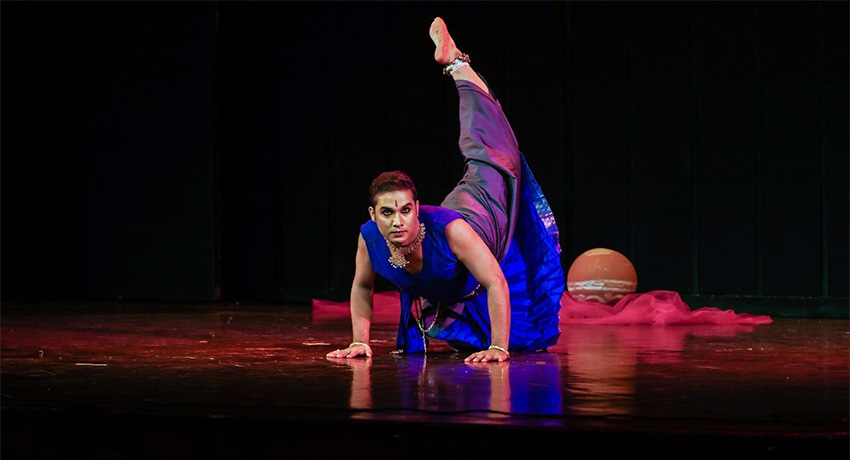
His greatest gratitude goes to his guru, Rama Vaidyanathan ji, who encouraged him to choose Bhojpuri as the language of his first production. “Her support gave me immense confidence,” he shares. The musical team included Shri Sridhar Vasudevan, who composed for the production and contributed his voice to the Carnatic sections and dialogues, while Jay Dadheech also contributed his talent. Senior flautist Shri Rajat Prasanna added his artistry, and Shri Himanshu Srivastava helped Vinay understand the deeper significance of Chhath Puja. His dear friend and well-wisher Sannidhi Vaidyanathan contributed as a mridangist, while the music was recorded at Neelam Studio under the guidance of Shri Prashant ji.
Creating a production that was so personal and unconventional was not without its challenges. “The biggest challenge was overcoming my own fear,” Vinay admits. “I knew I was attempting something completely new—a full Bharatanatyam production in Bhojpuri. As a young dancer, I understood that it could either create a new path or fail.”
Finances presented another major challenge. Balancing life in Delhi with a full-time job while managing music, costumes, logistics, rehearsals, and other production requirements was overwhelming. Yet, his conviction in the idea kept him moving forward. Today, he believes the challenge is not only creating meaningful work but also making it visible to larger audiences and encouraging people to understand the value of supporting and paying for art. “Productions require considerable investment, but I believe the subject and message are more important than the obstacles,” he says.
Vinay deliberately chose to present Abhadra as a solo production because the story was deeply personal to him. “It emerged from my own experiences, questions, and emotions, and I felt that a solo format would allow me to express them most honestly,” he explains. While he has immense respect for group productions and has learned extensively through performing in his gurus’ choreographies, he also wanted to discover his own artistic identity. “Watching Rama Vaidyanathan ji and the talented dancers around her taught me the importance of every artist finding their own voice,” he says.
He was aware that taking such a path involved the possibility of failure, but he was willing to take that risk while he was young. “I believe there is no real failure—only success or learning, and both are valuable,” he says.
Vinay also has a thoughtful perspective on the growing influence of social media in the performing arts. “Social media is a powerful tool, but we must remember that we should use social media, not allow social media to use us,” he says. According to him, platforms such as Instagram and Facebook help artists reach new audiences and communicate their ideas. Several opportunities have come his way because people discovered his work online.
At the same time, he believes there is a fundamental difference between creating a one-minute reel and performing a two-hour Margam. During a six-month break from the stage, Vinay created short videos sharing his thoughts on Indian classical dance, some of which reached millions of viewers across the globe. Social media also gave him the opportunity to interview respected artists such as Dr. Padma Subrahmanyam, Raja and Radha Reddy, and Meenakshi Seshadri. He was also invited to promote the Khajuraho Dance Festival through social media. “I believe social media can become a bridge between tradition and the modern world—provided we use it meaningfully,” he says.
Looking ahead, Vinay believes that his journey has only just begun. He is researching Bhojpuri literature and exploring how forms such as pad, Kajri, Sohar, and traditional Bhojpuri music can become part of the vocabulary of Bharatanatyam. Alongside this, he continues to work on the traditional Margam, particularly Varnams, while developing his own choreographies.
His larger vision extends beyond the stage. He wants to raise awareness about the linguistic and cultural challenges faced by the Bhojpuri-speaking community and is also working towards introducing classical dance education in villages and districts around his hometown. “I want children from those places to understand that art is not limited by geography or privilege,” he says.
Through his dance, photography, social media content, and video interviews, Vinay hopes to bring unheard voices into the spotlight. His philosophy is simple yet powerful: “It is okay to fail, even to fail miserably, but it is never okay to stop.” For Vinay Tiwari, the journey is about continuing to work with sincerity, consistency, and passion. “This is only the beginning, and I believe the sky is the limit.”