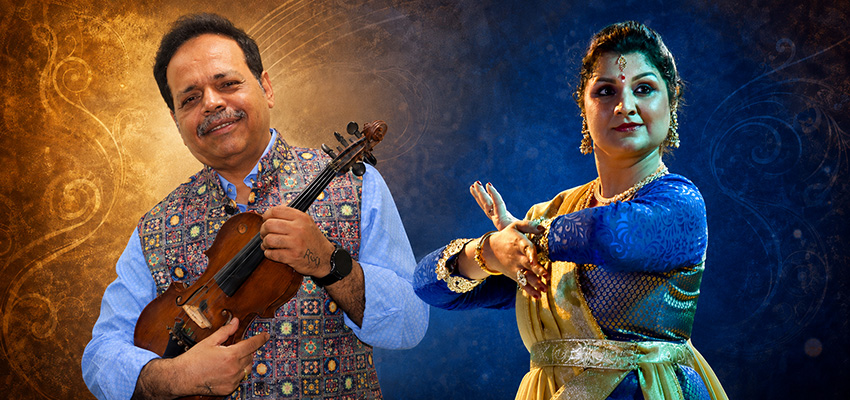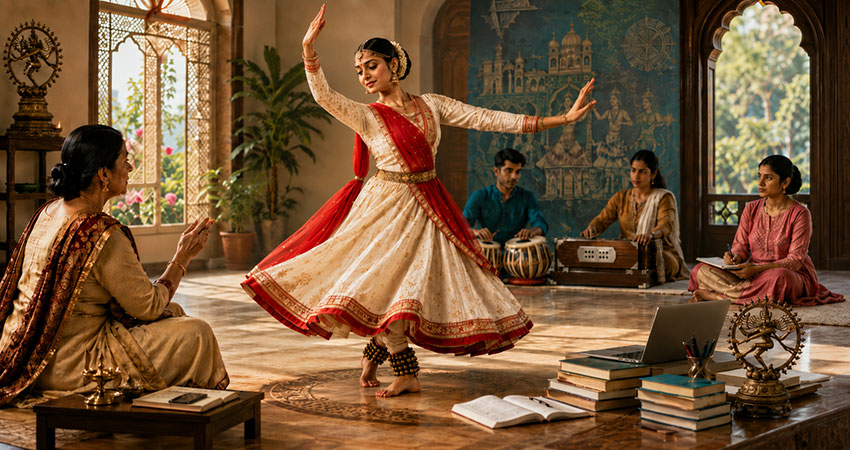
For many young dancers and their families, a degree in Kathak appears to offer a clear path into the world of classical dance. It provides structure, legitimacy, academic recognition and, in some cases, a bridge to professional possibilities. Yet, the question remains more layered than it appears: Can a three or four-year university programme truly create a complete Kathak artist?
The answer, perhaps, lies not in choosing between the university and the guru-shishya parampara, but in understanding how the two can speak to each other.
As Kathak increasingly enters formal academic spaces, the debate around degree-based dance education has become more urgent. What should a Kathak degree really teach? Should it focus primarily on technique and repertoire? Should it prepare students for stage performance? Or should it also train them to think, research, teach, write, choreograph, document and participate meaningfully in the larger cultural ecosystem?
To find answers, ClassicalClaps brings together two practitioner-teacher perspectives.
Guru Parwati Dutta, Founder Director of MAHAGAMI Gurukul Aurangabad, and Dean Performing Arts of Mahatma Gandhi Mission University represents a deeply rooted gurukul perspective shaped by years of training, teaching, institution-building and cultural work beyond metropolitan centres. MAHAGAMI is regarded among India’s premier Dance-Gurukuls and imparts training in Kathak and Odissi.
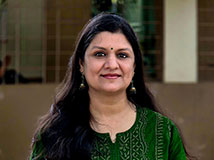
Dr Tina Tambe, a senior Kathak Exponent and Assistant Professor (Kathak) at the Maya Somaiya School of Music and Performing Arts at Somaiya Vidyavihar University, Mumbai, brings the perspective of a university faculty member, performer, researcher and teacher engaged with formal Kathak education, curriculum, student development and career preparedness.
Degree and Parampara: A False Conflict?
One of the most common concerns around formal dance education is whether the spirit of guru-shishya parampara can survive within the structures of a university system. Credits, semesters, examinations and learning outcomes often seem far removed from the intimate, continuous and deeply personal nature of traditional talim.
Guru Parwati Dutta sees this as a “false paradox.” In her view, a university dance education need not sacrifice the intimacy, rigour and continuity of traditional training. The solution, she suggests, lies in adopting what she calls a “modern Gurukul pattern” — a framework that is personalised and immersive, yet not orthodox or rigid.
For her, the true guru-shishya parampara is rooted in student-centric pedagogy, where the pace of teaching responds to the capacity of each learner, or paatra, while still being mindful of academic timelines and learning outcomes. Such training goes beyond the transmission of compositions. It includes micro-details, informal conversations, critical thinking and empathetic mentorship. The aim is not merely to help students memorise choreography, but to encourage them to understand the art form from within.
Dr Tina Tambe, approaching the question from within the university classroom, agrees that balancing both systems is challenging but possible. She emphasises the need for a comprehensive and carefully designed syllabus, experienced and committed faculty members, and infrastructure that supports all-round learning. For her, the strength of institutional education lies in structured syllabus design, interdisciplinary exposure, experiential learning, research and the use of digital media. These, she feels, must be combined with the values of the guru-shishya parampara: individual attention, dedicated riyaaz, deeper understanding of the art form, discipline, patience, humility and respect for the guru as well as the art.
Together, their perspectives suggest that the university and the parampara need not be adversaries. The real question is whether institutions can create an atmosphere where academic structure does not flatten the individuality of artistic growth.
Three Years Are Not Enough – But They Can Open Doors
A recurring point in Dr Tambe’s response is the need for realism. A graduation degree alone, she says, is not enough to make someone a performer, teacher or choreographer. Kathak requires years of learning, understanding and dedicated practice before a dancer can truly master the form or excel professionally.
This is an important caution in an age where degrees are often seen as endpoints. In the arts, a degree is better understood as a beginning. It can provide orientation, exposure, confidence and direction, but it cannot replace sustained talim.
According to Dr Tambe, a degree programme can introduce students to the many dimensions of the dance field. It can help them understand their strengths and limitations, discover their areas of interest, and explore possible career directions. Those who wish to teach must continue reading, researching, assisting their gurus and observing teaching methods at close quarters. Those interested in choreography, arts administration, curation or documentation must seek internships, field projects, job training and mentorship under experienced professionals.
This view is both practical and necessary. Not every student of Kathak will become a stage performer. Nor should performance be the only measure of success. A meaningful degree programme should help students recognise the larger ecosystem of dance and prepare them to contribute to it in multiple ways.
Rethinking Evaluation in Dance Education
One of the strongest points raised by Guru Parwati Dutta concerns assessment. While universities have increasingly acknowledged the value of immersive learning, she points to a serious execution gap in the way students are evaluated.
In many dance institutions and examination boards, assessment methods continue to follow outdated and rigid patterns. The examination system, according to her, has not experimented enough with newer and more responsive ways of evaluating artistic learning. This is a crucial observation because dance cannot be assessed in the same way as a purely theoretical subject. Nor can a dancer’s growth be captured only through fixed repertoire, standardised presentations or conventional written examinations.
If pedagogy becomes flexible, student-centric and immersive, evaluation too must reflect that spirit. A Kathak student’s progress may need to be assessed through sustained practice, musicality, understanding of tala, abhinaya, creative thinking, reflective writing, research, improvisation, performance maturity and the ability to respond to feedback.
Parwati ji’s point challenges institutions to think beyond examination as a mechanical end-point. Evaluation itself, she suggests, must become an extension of tradition — living, responsive and aligned with the artistic process.
Building Ecosystems Beyond Metropolitan Centres
Another valuable dimension in Parwati ji’s response comes from her experience with MAHAGAMI in Aurangabad. Her work has involved building a classical dance ecosystem outside the major metropolitan centres, where access, audience culture and social perception of classical dance may differ significantly.
She stresses that nurturing serious students and committed audiences outside large cities requires both uncompromising standards and local empathy. Institutions must remain aligned with the core aesthetics of Kathak without diluting the form or bending to commercial local tastes. At the same time, they must understand local challenges, community needs and existing perceptions of classical art.
This is a significant lesson for all institutions. Classical dance education is not only about producing individual performers. It is also about cultivating an environment in which the art can be understood, respected, practiced and sustained. In places where classical dance is not seen as an immediate necessity, the act of sowing the seed and nurturing the sapling becomes, as Parwati ji suggests, a sadhana in itself.
A strong Kathak institution, therefore, must move beyond a transactional model of education. It must think generationally. It must create students, audiences, mentors, spaces for dialogue and opportunities for continued engagement.
Beyond Performance: The Wider Career Question
For today’s Kathak student, career pathways are changing. Performance remains an aspiration for many, but stage opportunities are limited and highly competitive. A degree programme, therefore, must prepare students for wider possibilities without giving them unrealistic expectations.
Dr Tambe believes that institutions can support students by providing study material, infrastructure, mentoring connections, internship opportunities and exposure to different aspects of the dance field. The degree can give students vision, focus, fundamental knowledge, confidence and experience. It can also channelise their energies in the right direction.
This wider preparation is essential. Kathak graduates today may become performers, teachers, researchers, choreographers, arts managers, festival coordinators, content creators, archivists, curators, writers or cultural entrepreneurs. Some may work in schools and universities. Some may assist senior gurus. Some may create digital learning resources. Some may contribute to documentation and research. Some may design outreach initiatives. Others may develop new choreographic work rooted in classical grammar.
But none of these paths can be built on degree certification alone. They require continued learning, professional discipline and lived experience.
The Inner Life of a Kathak Graduate
If Dr Tambe’s response highlights the practical value of a degree, Parwati ji’s response draws attention to the inner life of the artist.
For her, a complete cultural professional must actively nurture the inner mind, thinking process and creative imagination. Indian art, she reminds us, relies heavily on refined sensibilities and symbolic thinking. These cannot develop through technique alone. A dancer must spend time with visual arts, literature, scriptures and philosophical writings. The dancer must also cultivate solitude — the ability to sit with one phrase, rhythmic or thematic, and allow it to mature.
This is perhaps one of the most important ideas for young students. Kathak is not only movement. It is thought, memory, rhythm, poetry, body, silence, emotion and intellect. A student who only learns compositions may become efficient. But a student who learns to think, reflect, read, write and observe may grow into an artist.
Parwati ji also emphasises the importance of writing personal notes, reflections and observations. This habit can gradually help a dancer move from being only a performer to becoming a researcher, writer and innovator within the ecosystem. She also encourages artists to step outside commercial and academic loops by sharing their art through community-centric activities — workshops in underserved areas, performances for residents in care homes or hospitals, and other forms of cultural outreach.
In this view, the Kathak graduate is not merely someone who has completed a syllabus. The graduate is someone who has begun to understand the ethical, intellectual and social responsibilities of being an artist.
What Should a Kathak Degree Finally Do?
Both voices arrive at a shared understanding: a Kathak degree cannot, by itself, create a complete artist. But a well-designed degree programme can create the conditions for one.
It can offer structure without killing spontaneity. It can introduce students to history, music, theory, aesthetics, research and allied fields. It can encourage riyaaz, discipline and humility. It can expose students to career possibilities beyond the stage. It can help them understand that performance is not the only destination. It can create confidence, awareness, sensitivity and direction.
Most importantly, it can help students realise that Kathak is not a subject to be “completed” in three or four years. It is a lifelong practice.
A degree can open the door. The journey, however, still demands surrender, patience, reflection and years of committed work. The best Kathak education, whether in a gurukul or a university, must prepare students not only to dance, but to think, serve, create and carry the tradition forward with responsibility.