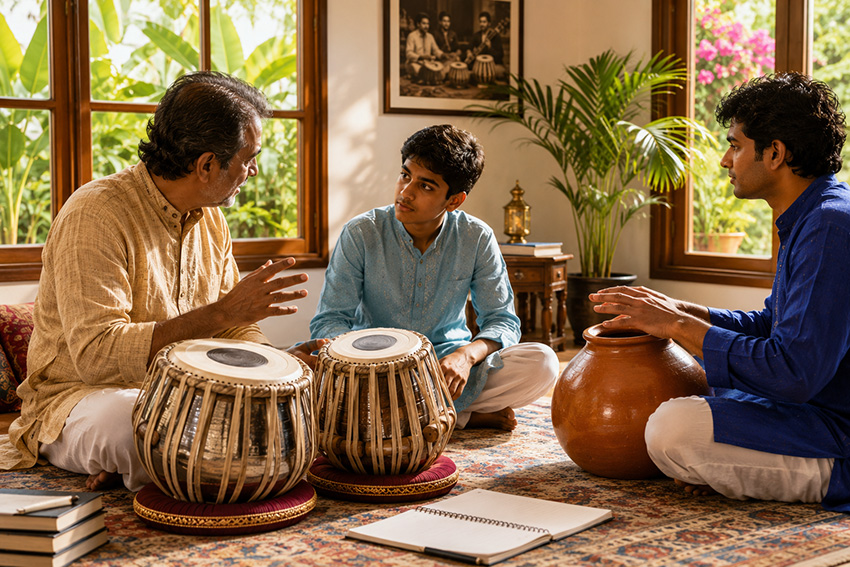
As technology opens unprecedented access to learning and young percussionists acquire increasingly impressive technical skills, what happens to repertoire, identity, listening, patience and musicianship? Senior percussionists Dr Aneesh Pradhan and Dr Suresh Vaidyanathan reflect on the changing landscape of percussion education, while tabla performer, researcher and educator Dhaivat Mehta brings the perspective of a younger generation navigating traditional taleem, academia and technology.
There has perhaps never been an easier time to learn rhythm.
A student of percussion today can listen to masters across traditions, watch performances repeatedly, attend online lessons with teachers thousands of kilometres away, access compositions and exchange material with fellow students. Social media also allows young musicians to present their playing before audiences much earlier in their musical journeys.
But greater access raises a more fundamental question: what kind of musician is that access helping to create?
For percussion education, technique and rhythmic command are indispensable. But a percussionist must also learn to listen, respond, accompany, understand repertoire, recognise musical space and develop an aesthetic understanding of music.
So, as methods of learning change, are we simply producing more technically equipped percussionists — or developing complete musicians?
Two Systems of Learning – and the Space Between Them
Dr Aneesh Pradhan, one of India’s leading tabla artistes, is a disciple of the illustrious tabla maestro Nikhil Ghosh and has inherited repertoire spanning several tabla gharanas. A performer, educator, researcher and author, his work has engaged extensively with the history, pedagogy and performance practices of Hindustani music.
Dr Pradhan places today’s changes within a much longer history.
“Over the past century and more, classical or art music has been taught along two broad lines: via the guru-shishya traditional method or through institutionalised music education,” he observes.
He is careful not to see the two as watertight compartments. Teachers working in one system have consciously and subconsciously drawn from the other. Broadly, however, their objectives can differ.
The guru-shishya training format traditionally focused on preparing students to become professional performers. The emphasis was therefore on transmitting the “knowledge, scholarship and wisdom” that gurus themselves had imbibed – including repertoire, technique and ideas about presentation.
Institutional training, meanwhile, equips students with degrees that may provide opportunities to teach in schools, colleges and universities.
Dr Pradhan feels that the institutional format tends to stress theoretical aspects more and practical output less. One important reason, he points out, is the shortage of time compared with the years of training possible within the traditional setup. Students of tabla and pakhawaj may therefore acquire information about the content and technique of different gharanas, but this can sometimes remain superficial compared with what may be imbibed through sustained traditional training.
The question, then, is not necessarily which system is superior, but whether contemporary pedagogy can combine the strengths of both without sacrificing depth.
More Access – But Greater Sameness?
Technology has complicated this relationship further. The guru is no longer the student’s primary gateway to the larger musical world.
Dr Pradhan observes that students now have many avenues to imbibe consciously and subconsciously from sources other than their gurus.
“Often, this results in imitation at various levels since the original sources are charismatic personalities many of who have a cult following,” he says.
He also sees education in tabla and pakhawaj increasingly focusing on mathematics pertaining to music. Cross-rhythmic work and complex mathematical phrasing, often influenced by Carnatic rhythm, seem to have gained importance compared with the study of the vocabulary and poetry involved in the repertoire of these instruments. Alongside this, he observes an emphasis on speed and a choice of specific vocabulary as a vehicle for demonstrating it.
The result, he says, can be surprising:
“There is often a sameness to the tonal quality, vocabulary and repertoire, despite students being trained by different gurus.”
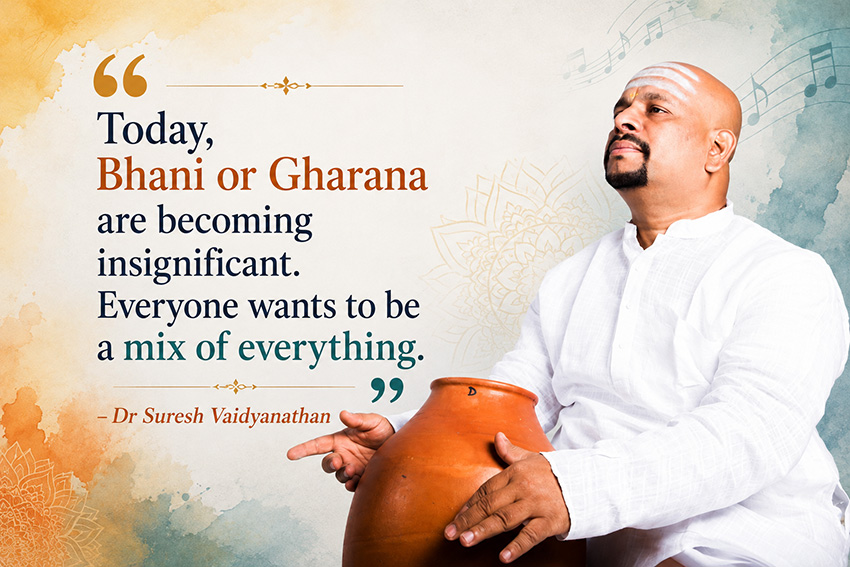
From the Carnatic tradition, Dr Suresh Vaidyanathan identifies a remarkably similar development.
An acclaimed ghatam virtuoso and multi-percussionist, Dr Vaidyanathan’s playing combines the Pazhani and Umayalpuram bhanis. He teaches South Indian percussion through ghatam, mridangam, kanjira and konnakol, and has also trained in Carnatic vocal music. He was the first ghatam vidwan to earn a doctorate in Rhythmology from the University of Madras, for his research on the evolution of the ghatam.
Dr Vaidyanathan readily acknowledges technology’s positive impact. “The gates are wide open,” he says, allowing any seeker to reach a probable educator and negotiate short- as well as long-term coaching. He also sees open-mindedness among students in sharing knowledge and supporting one another’s growth.
His concern is what may happen after those gates open.
He feels that the upcoming generation increasingly weighs skill and knowledge as commodities and, caring less for the guru’s repertoire and guidance – including the choice of what to listen to – students often choose to learn from and emulate the most visible performing artistes.
This, he argues, is resulting in “a surge of homogeneous performers despite belonging to unique schools of thought.”
Coming independently from senior practitioners rooted in Hindustani and Carnatic traditions, these observations present an intriguing paradox:
When students have access to more musical diversity than any generation before them, why might their playing become less distinctive?
Speed Isn’t the Problem — The Rush May Be
Speed is an easy target in conversations about contemporary percussion. Neither Dr Pradhan nor Dr Vaidyanathan, however, dismisses speed itself.
Dr Pradhan points out that speed was an element in tabla even earlier, but it was balanced with an education that looked at varied repertoire and the particular demands that such repertoire presented. Different compositional forms and compositions within those forms traditionally provided a broad sense of speed.
More importantly:
“The idea that music-making was about expression and communication was more important.”
Dr Pradhan does not see speed as inherently at loggerheads with musical maturity or aesthetics. Performers, he says, choose to present their work according to their understanding of what music and art mean to them.
“If music-making is about creating an impression on the audience, the musical presentation will follow accordingly.”
He also points to subtler changes affecting contemporary tabla performance – including the choice of tonic note for tabla solos and the insistence on specific microphones – which contribute to creating a sonic image different from the one that existed in the past.
Dr Vaidyanathan similarly says that “speed in rhythm is subjective and rhythm is basically melodic.” With guided practice, he believes, a demanding composition can be played at different stages or tempos.
What concerns him is the rush surrounding that achievement.
“Patience is becoming irrelevant,” he observes, with the emphasis increasingly on performance rather than learning.
Before the teacher can help the student realise the aesthetics, sensitivity and bliss inherent in time-tested compositions – and initiate proper guided practice, including caution about wastage of energy and injuries – students with weak foundations may already be attempting to impress the world through self-promotion in media.
Perhaps, then, the real concern is not whether young musicians are playing too fast, but whether their musical development is being given enough time to move slowly.
The Guru-Shishya Relationship in a Digital World
Technology has changed not only what students can access, but also the relationship between guru and shishya.
Dr Vaidyanathan points to an interesting reversal. Many senior gurus come from a generation of deep reverence towards their own teachers. Yet those same gurus may struggle to cope with the “made-up demands of social media” and look to their shishyas for guidance, making the traditional hierarchy, in his words, “muddled.”
The student may now possess technological and platform knowledge that the guru does not. That need not diminish the guru’s musical authority, but it changes the dynamics of a relationship that has traditionally been central to transmitting musical knowledge.
The challenge, therefore, may not be to resist technology, but to understand where technology’s role ends and mentorship begins.
Creating Musicians, Not Just Percussionists
Ultimately, all these questions converge around what a percussionist is being trained to become.
For Dr Vaidyanathan, accompaniment makes this particularly clear.
A guru preparing a Carnatic percussionist, he argues, must be equipped with knowledge of a variety of lyrical compositions, their structural arrangements, syncopated compositions and even the emotions they convey. With this understanding, the teacher can guide the student in general grooving, responsiveness and embellishment.
The percussionist must learn to be unobtrusive, share space with co-percussionists, remain alert to spontaneous improvisations and respond to arithmetic arrangements.
This education extends far beyond regular classes.
The student, Dr Vaidyanathan says, should constantly stay with the teacher through regular classes, attend the guru’s concerts and performances of other percussionists, and listen to performances of yesteryears with the guru’s guidance.
Through this process come lessons in “proportions, restraints, spaces, sense of acoustics and other intricacies besides rhythm.”
It is necessarily a long-term process requiring commitment and trust between guru and shishya. Dr Vaidyanathan also places responsibility on parents and relatives to patiently support the student for sustained growth.
“If the guru has belief and responsibility regarding the tradition he belongs to, and is uncompromising on pressures,” he says, “the system can stay tall with all pride.”
Dr Pradhan reaches a similar destination from the Hindustani perspective.
Tabla has been recognised as a solo instrument for several decades, he points out, although it is now being featured on larger concert platforms. But whether students ultimately become soloists or accompanists, pedagogy, he believes, must look beyond producing instrumental specialists.
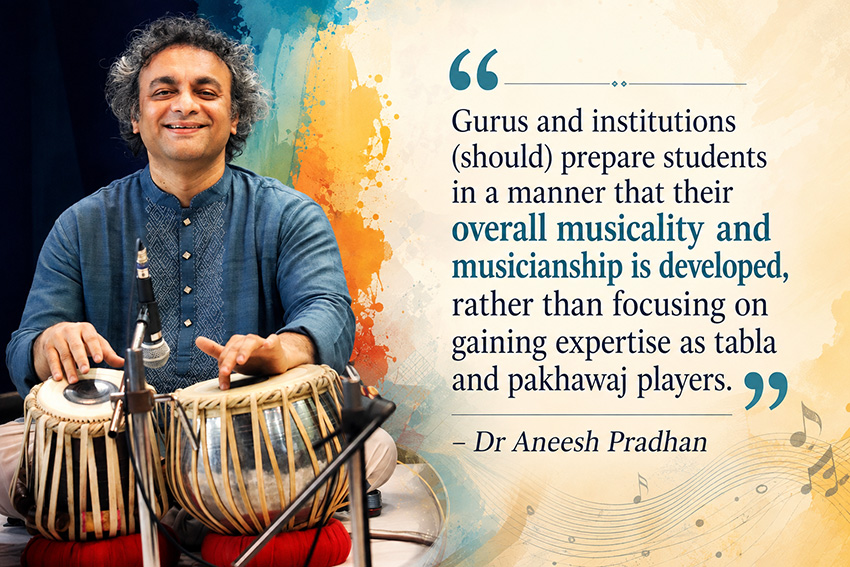
And his next observation perhaps encapsulates the central argument:
“Expertise for these instruments cannot be gained without a holistic musical perspective.”
A View from the Next Generation
How do these concerns appear to a younger musician who has himself experienced traditional taleem, university education, research and contemporary teaching?
Dhaivat Mehta, a tabla performer and researcher, is a Faculty at the Maya Somaiya School of Music and Performing Arts, Somaiya Vidyavihar University, Mumbai. He has trained for 19 years under Dr Aneesh Pradhan after beginning with Shri Harshesh Mehta, and has also pursued postgraduate studies in tabla and doctoral research. His journey places him at an interesting intersection of the very systems of learning discussed in this feature.
Mehta sees considerable value in technological change. Apps, software tutorials, YouTube and other digital resources, he believes, have made percussion education more global and flexible. He also values the communities created when young performers and students practise together, learn from one another and build confidence.
Yet he draws a clear boundary:
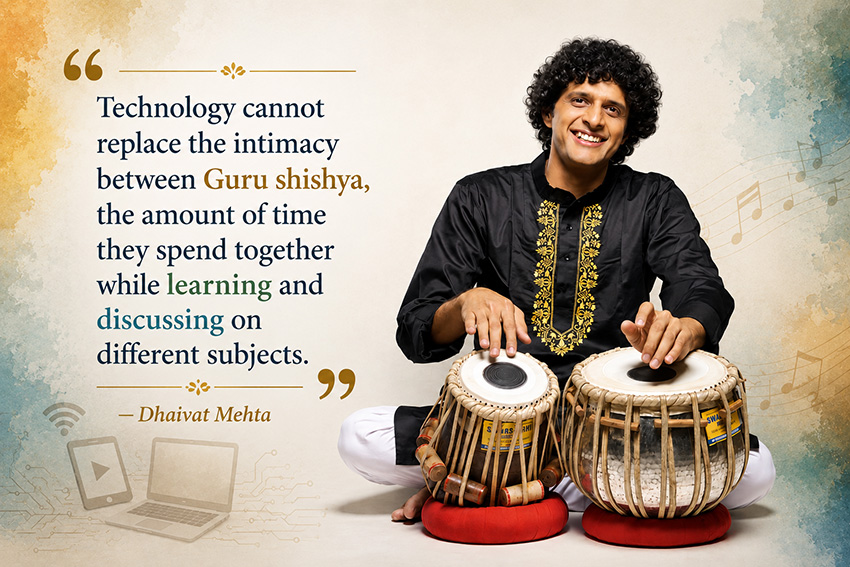
For Mehta, technology is a medium rather than a substitute for guidance. Students can access information and revisit material independently, but assessing progress and directing musical development remain responsibilities of the guru.
His experience within academic education adds another dimension. Mehta would like percussion students to engage more deeply with areas such as rhythmic systems, ethnomusicology, pedagogy and comparative history alongside rigorous practical training.
On the question of virtuosity too, his position resonates with the senior voices:
“Speed is important but not at the cost of losing your roots and basic knowledge and clarity.”
For Mehta, slow-tempo practice, careful listening, clarity, dynamics and aesthetics remain fundamental.
His perspective suggests that a younger musician need not choose between tradition and technology, or between taleem and academia. The challenge is learning how to use each without allowing one to replace the depth offered by another.
What Must Remain When Everything Else Changes?
Technology has widened access. Institutions have created academic and professional pathways. Students can encounter musicians, compositions and traditions that earlier generations might have struggled to access.
None of these perspectives calls for rejecting those changes. Nor do they suggest that speed, virtuosity or mathematical sophistication are enemies of musical depth.
Their concerns lie elsewhere.
Can access exist without imitation? Can students encounter multiple traditions without losing the distinctive vocabulary of their own? Can technical accomplishment coexist with patience? Can institutions provide academic breadth while preserving the depth of sustained taleem? And can technology supplement the guru without beginning to substitute for the relationship itself?
Perhaps percussion education cannot ultimately be measured simply by how many compositions a student knows, how complex the rhythmic calculations are or how quickly they can be performed.
A percussionist must learn to listen before responding, understand space before filling it, know when to lead and when to accompany, and gradually discover an individual musical voice without losing sight of the tradition that nurtured it.
The tools of learning will continue to change.
The larger purpose of learning need not.
Are we teaching students how to play percussion — or are we creating musicians?