For youth dance icon Kumar Sharma, singing and dancing have always been inseparable parts of his artistic identity. Although he initially pursued vocals at his parents’ insistence, destiny gradually led him towards Kathak. His journey began in the fifth grade when his school dance teacher, Pt. Shri SitaRam ji, noticed his musical ability and started casting him as a background singer and harmonium player for his Kathak choreographies. Watching his guru teach while he provided the music gradually opened his eyes to the beauty of dance. A defining moment came when he watched Madhuri Dixit’s performance in Devdas. “I suddenly realised, this is the same art form my teacher performs,” he recalls. “That was the moment I fell in love with Kathak.”
 Sharma trained under Pt. Shri SitaRam ji for six years until his passing, while simultaneously developing his vocal skills under Smt. Shakuntla ji and Shri Sanjeev Sharma ji. He later received training in Taal Vidya from Pt. Divyang Vakil ji. “I am the product of the combined wisdom of all my gurus,” he says, acknowledging the profound influence they have had on his artistic journey.
His pursuit of higher education brought him to Mumbai, where he initially intended to complete his Master’s in Dance. However, circumstances forced him to rethink his plans. Restrictions at Nalanda prevented him from taking outside performance and television opportunities, while his father had given him only two years to establish himself in Mumbai before returning to Punjab. His close friend and guide, Jazim Sharma, suggested that he pursue a Master’s in Music at Mumbai University instead. “I still vividly remember my audition. I sang Raag Bihag, secured my admission and even got hostel accommodation,” he recalls. At the same time, he continued his Kathak education and completed his Visharad from Pracheen Kala Kendra, Chandigarh. “Those two years became a masterclass in balancing melody and movement under pressure,” he says.
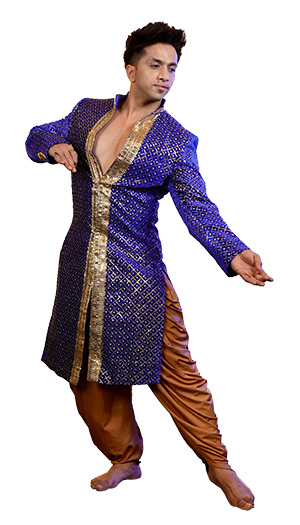 Known not only for his dancing but also for his striking physique and stage presence, Sharma believes physical presentation plays an important role in a male dancer’s performance. “I have always believed that a male dancer’s body is his primary ornament,” he explains. “Your body is your makeup; it is the canvas that reflects your discipline.” According to him, every aspect of a performer’s appearance—from physique and posture to costume—contributes to commanding the audience’s attention. His years in reality television further strengthened this belief, teaching him that presentation can be almost as important as performance itself.
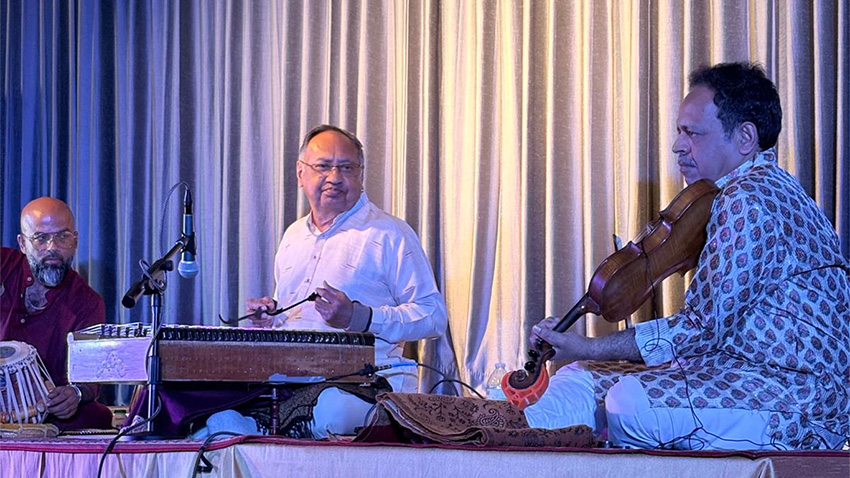
Reality television has played a significant role in Sharma’s career, but among the many shows he has been associated with, Dance Deewane remains especially close to his heart. “For three months, I lived a dream I had since childhood—performing in front of my idol, Madhuri Dixit ji,” he says. Having already established himself through previous television appearances, Sharma was given considerable creative freedom by the show’s team. He was even able to incorporate live musicians into his performances. “Nearly every performance was met with a standing ovation,” he recalls, describing the experience as one of the finest phases of his career.
While Sharma acknowledges the enormous role reality television once played in launching dancers, he believes the industry has changed considerably. “A few years ago, making the Top 10 of a reality show was a life-changing milestone,” he says. “Today, television remains a prestigious platform, but it no longer guarantees superstar status or a steady stream of work.” The rise of OTT platforms and social media has transformed the way artists build careers. “The hustle doesn’t end when the show does—you have to be your own PR and digital creator,” he observes. For dancers today, he believes consistent digital content and an evolving social-media presence are essential for sustaining visibility.
Sharma also offers a candid perspective on the much-debated authenticity of reality shows. “I always say that the only true ‘reality’ in a reality show is the dance itself,” he says. The moment the music begins, there are no retakes; dancers must perform regardless of mistakes, exhaustion or injury. “That raw, uninterrupted moment is the truth,” he insists. While acknowledging that stories, jokes and emotional narratives may be shaped for television, he maintains that the talent displayed on stage remains genuine. “If you are watching for the dance, you are seeing something real; if you are watching for the drama, you’re only seeing half the truth.”
He is equally concerned about the increasing emphasis on spectacular lifts, cartwheels, splits and stunts. Sharma respects every dance genre, but feels that physical risk can sometimes overshadow artistry. “Pure dance is often being replaced by gymnastics, lifts and stunts,” he says. Although such performances have raised the bar for physical athleticism, he believes dancers must be careful not to lose the soul of movement. “I have always remained committed to dance-heavy acts,” he says. “For me, the integrity of the art form should always come first.”
This philosophy is at the heart of his dance company, Kathak Rockers, and his approach to Kathak Fusion. Sharma describes his fusion work as a “honey trap”—a creative strategy to draw young audiences towards classical tradition. “My goal has always been to bring people back to our roots, and I realised that to do that, I had to meet them where they are,” he explains. He teaches Kathak before introducing fusion choreography in his workshops and often presents pure classical Kathak before a fusion performance. “Time and again, audiences find themselves more captivated by the tradition than the trend,” he says. Messages from young people telling him they began learning Kathak after watching his videos are, for him, proof that the idea is working.
Looking ahead, Sharma dreams of taking Kathak Rockers to every corner of the world, performing on major stages and iconic festivals while inspiring a new generation to connect with Indian heritage. His message to aspiring dancers is simple but powerful: “Content without craftsmanship is temporary.” He cautions young artists against merely copying what they see on social media without understanding the riyaaz behind it. “True art cannot be rushed,” he says. “If you dedicate yourself to your craft with the right intentions, the world will eventually notice. A ‘slow’ journey often leads to a much longer and more respected career than an overnight sensation.”