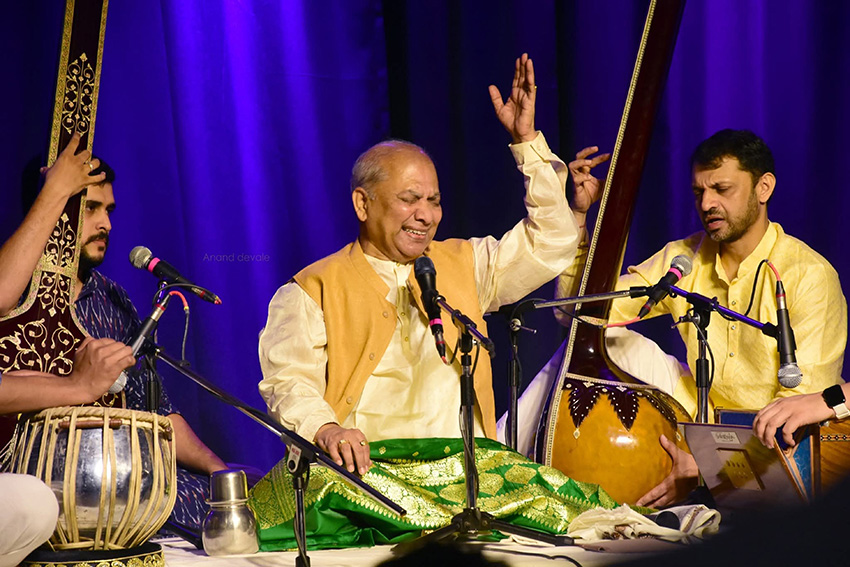
In a city of morning rush and bustling streets, GRACE Foundation brings a soulful and enlightening opportunity to begin your day right with the debut Mumbai concert of ‘Morning Ragas’ presented by Pancham Nishad. The visionary behind this initiative Shri Shashi Vyas, founder of GRACE Foundation, through this platform aims to create an archival record of rarely heard morning ragas. Veteran Hindustani classical vocalist Pandit Suhas Vyas, disciple and son of Padma Bhushan Pandit C.R. Vyas will be presenting a thoughtful collection of six rarely performed ragas designed to be sung in the morning. In conversation with Shri Suhas Vyas, we dive deeper into the conception of this event, and learn more about his training under a legendary father.
Suhas ji credits the inception of this series to his brother Shashi Vyas, whose classical training and observational skills, along with the creative outlook of their father Pandit CR Vyas, have shaped his artistic vision. Pancham Nishad has been curating concerts for around 30 years, aiming to provide a platform to upcoming artists as well as stalwarts. This specific concept of ‘Morning Ragas’ is of particular significance due to Shashi ji’s thought behind it. Over the past two to three decades, there has been a rise in evening concerts due to the generalised working schedules. “When do I listen to Sarang [an afternoon raag]?” says Suhas ji, because these evening concerts restrict performers to a particular mood. With morning concerts and consequently morning ragas becoming a rarity, this concert series intends to expand the scope of this repertoire. Although information regarding these ragas exists, the talim or training required to perform them is hard to come by, which is why the selection of these specific ragas for this showcase is exceptional.
The Time Theory of Classical Music prescribes a set of Ragas to be sung and listened to right from the first up until the eighth prahar of the day. The understanding of this theory is what leads a performer to create a certain mood through their music. “We are attached to our nature” he says, meaning that regardless of how skilled a performer may be, the entire bhava of a particular set of notes will only be most impactful when it is sung at the appropriate time. Ultimately, human behaviour is driven by their inherent nature, hence these mood aligning ragas have been thoughtfully assigned a particular time of day by ancient musicologists and scholars. The showcase opens with Ahir Lalat which is a combination of Raga Ahir Bhairav and Raga Lalat. A creation of Ustaad Alauddin Khan sahab, this raga has been widely performed by instrumentalists, but sparsely in vocal music and was popularised by CR Vyas ji. The next raga is Dugam Hindol, an innovation of the legendary Shri Ramkrishnabuwa Vaze, with the unique characteristic of having two gandhar and two madhyam svaras.
In the second half of the event, rasikas can enjoy the gentle beauty of Todi through the rendition of Varathi Todi which is a combination of three ragas, with Todi being the most dominant. This shall be followed by Dev Gandhar which is a traditional raga and Salang, a variation of Sarang. The repertoire concludes with another traditional raga, Jogia Asavari which is a speciality of the Gwalior gharana and was exceptionally mastered by Pandit Mallikarjun Mansur.
Suhas ji says that the essence of Raagsangeet is “Bandhanat rahun mukta houn gaane” [Being liberated through music while being bound in singing]. The changing trends in performing have impacted a musician’s journey. An observation he states is that classical music will never be “massical.” It will not sell out stadiums without risking a compromisation of musical integrity. He recalls his first time witnessing the maestro Ravi Shankar as a schoolboy, wherein the performance lasted for over nine hours. Comparing that to today’s time, even if artists are willing to perform, there are no audiences willing to sit through a concert that long. Additionally, in order to perform for longer durations an artist must have the capacity, and mastery over a vast repertoire, and for that to occur there must be instructors capable enough to train the vocalist. Regardless, he believes that an archival record of these ragas must exist, which is why through diligent riyaaz of over several weeks, Suhas ji has chosen to present this showcase so that future generations can have access to it.
Furthermore, another concern discussed by Suhas ji pertaining to the training of future generations was that of the institutionalisation of artistic education. ‘Degrees are important’ he says, and the system created by Bhatkhande and Paluskar fulfills a larger purpose in authentication and systemization of schooling that shapes a holistic and well learned artist. However, there do exist certain flaws in the system that need to be rectified if it were to maintain efficiency. Recollecting an anecdote, he mentioned how his father was once invited to a reputed university as an examiner for the M.A. assessments and failed all the appeared students. The reason for this being that the students were unable to simply play the tanpura. Appalled at this he felt that he had no other choice but to fail them. This raises the question of whether the existing university establishments are capable of providing a well balanced performing arts education. Acquiring information and gaining knowledge are two entirely different things, and that is what differentiates a singer from a performer. Giving examples of Marris College, Lucknow (now Bhatkhande Sanskriti Vishwavidyalaya) and SRA Academy, Kolkata that has produced renowned artists such as the late Ustad Rashid Khan and Pandit Ajoy Chakrabarty, Suhas ji emphasizes that such institutions do exist and have been succeeding in their mission. It is the responsibility of similar institutions to uphold such standards by maintaining a transparent instruction system that focuses on important aspects of education such as riyaaz and sanskaar.
Suhas ji mentions that he highly benefited from the structure he was trained under, which allowed him to merely listen to music, which became a resource for learning. He specifies the importance of listening and observation as the greatest medium through which an artist develops. Nowadays, he remarks, artists rarely go to listen to their own contemporaries, unlike previously when a majority of classical music baithaks were filled with other artists themselves. A learned audience puts responsibility upon the performer to present their best. Unknowingly, an artist learns the most through listening, Suhas ji highlights.
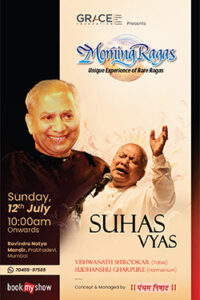 Audiences have undoubtedly evolved, and the question of relevance plagues newer artists. Nonetheless, Suhas ji firmly believes that human nature will persist over these rapid changes in the world of playlists and algorithms. Abhijat Sangeet shall remain eternal, because a mehfil can only be enjoyed by actually going to one. Humans crave artistic expression and that is reflected in the relationship between artist and spectator. The audience relishes performance just as a performer values applause. To achieve this synchrony, and to fulfill their mission of archiving uncommon ragas GRACE Foundation and Pancham Nishad launch their ‘Morning Ragas’ series this Sunday, July 12, 2026, at 10:00 a.m. at the Ravindra Natya Mandir, Prabhadevi, Mumbai.
Witness the rich musical legacy performed by Pandit Suhas Vyas and narrated by Sharvari Nagvekar in this showcase of six rarely heard morning ragas.“These ragas demand years of dedicated talim and riyaz before they can be presented with conviction. I consider it my responsibility to share this rich musical heritage with today’s listeners.” The performance will be accompanied by Vishwanath Shirodkar (Tabla) and Sudhanshu Gharpure (Harmonium). This initiative by GRACE Foundation is a part of their larger pursuit of cultural preservation, and this project is proudly supported by IRB Infrastructure under its CSR initiative.