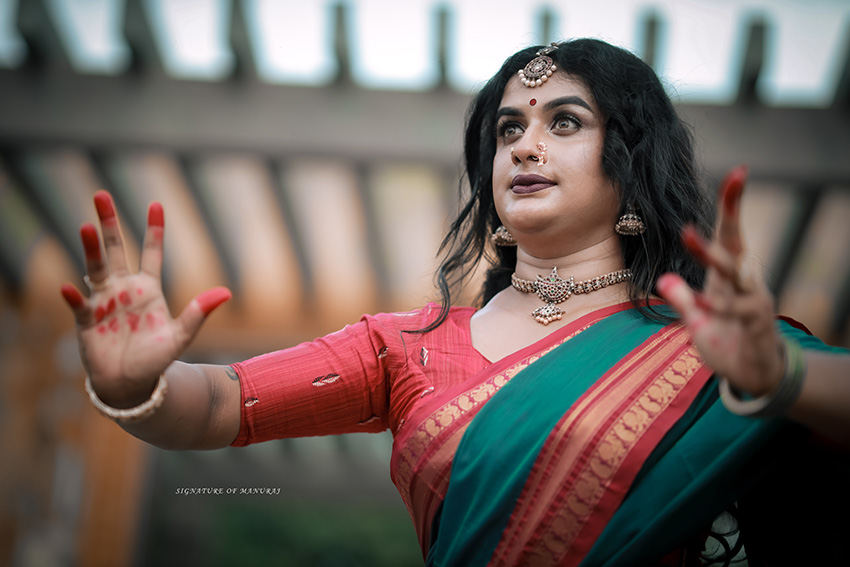
Her journey into classical dance began so early that she does not remember exactly when it started. Her elder sisters were her first teachers, and what began as imitation gradually blossomed into a lifelong passion.
Her formal Bharatanatyam training began under Sri Jeevan and Sri Thiruvallom Sundaresan. She later learned from Sri RLV Raghu Narayanan, Sri Varanadu Saji, Guru Sri Pattom G. Sanil Kumar, and Smt. Kalakshetra Jisha Raghav. Each of these gurus played an important role in shaping her artistic journey. Acharyan Sri Dr. G. Ratheesh Babu introduced her to the professional world, while Acharya Dr. Rajashree Warrier deepened her understanding of abhinaya. She remains deeply grateful to all her gurus.
 Today, Adrija Das is known as a Bharatanatyam dancer, educator, writer, activist, and budding politician from Kerala. She is also recognised as a transgender artist whose personal journey of self-realisation has become an integral part of her artistic expression.
What draws her most strongly towards Bharatanatyam is its rich repertoire of female-oriented narratives, particularly the emotional depth of Nayika Varnams, Padams, and Ashtapathis. Through these compositions, she explores longing, strength, devotion, vulnerability, and individuality. These themes resonate deeply with her understanding of womanhood.
For her, Bharatanatyam became much more than an art form. It became her voice—a medium through which she could express her deepest emotions, connect tradition with personal experience, and communicate stories that are simultaneously classical and contemporary.
She views the traditional concept of Natyaveda as fundamentally inclusive. According to the tradition, dance was created by Brahma as a universal art for humanity and was later codified by Bharata Muni in the Natya Shastra. In her understanding, dance has never belonged exclusively to one gender.
Shiva, the Adi Narthaka, represents the cosmic forces of creation, preservation, and dissolution, while Vishnu’s Mohini form represents grace, transformation, and the transcendence of conventional gender boundaries. These examples reinforce her belief that Indian classical dance has always contained a fluid and expansive understanding of identity.
As a male dancer in the early part of her career, she faced stereotypes and questions about whether she truly belonged in a space that was often perceived as predominantly female. Rather than allowing these perceptions to restrict her, she used them as an opportunity for self-exploration.
Over time, she came to understand and embrace her identity as a woman. Her journey made her realise that dance itself has no gender.
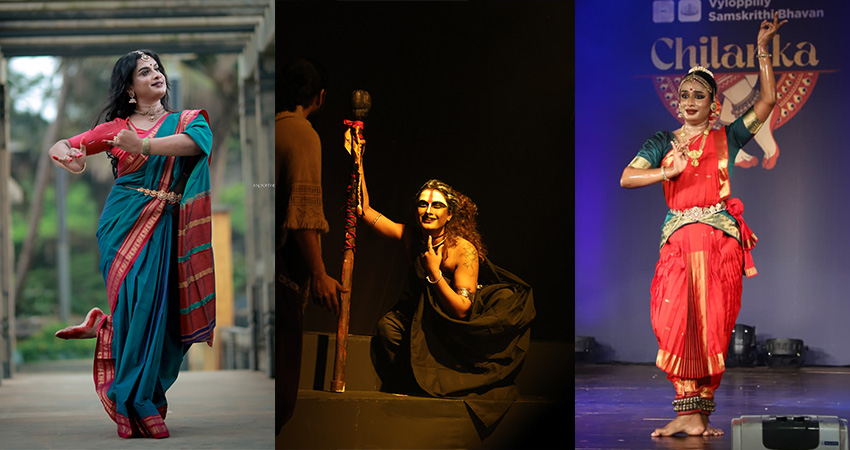
For her, the journey was never simply about transforming from a male dancer into a female dancer. While people may describe it physically in those terms, she believes that emotionally and mentally she had always been a woman.
As a child, she naturally gravitated towards flowers, dolls, kitchen sets, and other things society traditionally associated with girls. Wearing pants and shirts did not give her the same happiness as secretly wearing her mother’s saree or her sisters’ bangles. Those moments gave her a feeling of completeness.
As she grew older, bullying and social expectations made it increasingly difficult for her to express that side of herself. Yet the woman within her remained. Her story, therefore, is not about becoming someone else; it is about finding the courage to become the person she has always felt herself to be.
Her journey within the dance fraternity was met with varied reactions. Some members supported her wholeheartedly and understood her transition as an expression of self-realisation. They recognised that being authentic had added greater emotional depth and honesty to her abhinaya.
Others found it difficult to accept her journey. There were questions, judgments, and moments of distance. Yet she remained committed to both her truth and her art.
Over time, she felt that her life and work began to speak louder than prejudice. Today, she feels accepted by the community, and she believes that this acceptance was built through honesty, courage, perseverance, and the strength to remain true to herself.
Performing Bharatanatyam on stage as a woman now feels natural and complete to her. Earlier, she had the same dedication to the art, but there was an inner disconnect. She was expressing Bharatanatyam while simultaneously searching for herself within it.
Today, that disconnect has disappeared. The technique remains rooted in the same classical discipline, but her expression has become more honest, confident, and deeply personal.
She does not see Bharatanatyam as belonging to one gender or another. For her, it is neither “their zone” nor “her zone”; it belongs to everyone.
She does not define her journey through envy or competition. She believes every dancer has a unique path, with individual struggles and achievements. For her, the spirit of Natyaveda is one of inclusiveness—a universal art that transcends caste, religion, race, creed, gender, and politics.
She believes that this inclusiveness represents the true spirit of Indian classical dance.
To anyone who feels trapped or disconnected from their own identity, she offers a message of patience and self-discovery. She believes that the body should not be considered a limitation but an instrument.
She encourages people not to rush into becoming someone else. Instead, she believes they should listen to themselves, discover what feels authentic, and give themselves the time and courage necessary to understand their own journey.
For her, dance can be a powerful tool to explore, heal, and express—not to hide from oneself, but to discover oneself. When the body and soul move together, she believes, true art begins.
Every performance has a special place in her heart, but performing at the Koothambalam of Kerala Kalamandalam remains particularly sacred. The space has been sanctified by generations of legendary artists, making the experience deeply meaningful to her.
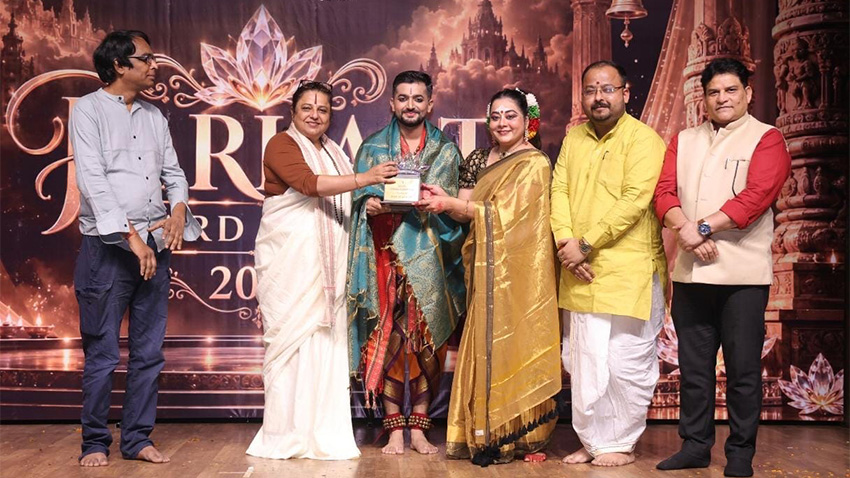
Receiving the Natwar Gopi Krishna National Award from AIDA remains another memorable milestone. She later had the honour of serving as a jury member for the organisation in 2022.
Her A-grade qualification in Bharatanatyam from Doordarshan was another important achievement. Being empanelled with SPIC MACAY enabled her to take classical dance to younger audiences and introduce them to the richness of India’s artistic traditions.
Another landmark moment came when she became the first transgender jury member in the Kerala School Kalolsavam. For her, this was significant not merely as a personal achievement, but as a meaningful step towards greater visibility and representation for the transgender community.
Her ambitions now extend beyond her personal artistic journey. As a dancer, educator, writer, activist, and budding politician, she hopes to use her experiences and her art to create awareness, inspire change, and build inclusive spaces where equality, dignity, and opportunity are accessible to all.
She believes that art and public life can work together to create meaningful social transformation.
When asked whom she admires most, her answer is perhaps the most revealing aspect of her personality: herself.
Her answer is not rooted in arrogance or a lack of respect for others. She deeply admires many dancers, writers, leaders, artists, and people who have influenced her life.
But she believes that only she truly understands the struggles, doubts, self-realisation, sacrifices, and growth that have shaped her journey.
She admires herself for having found the strength to stand, the courage to be authentic, and the determination to continue despite adversity.
Her message to others is therefore simple and powerful: Admire yourself.
For her, self-admiration is not arrogance. It is an acknowledgement of one’s own journey, resilience, courage, and worth.
Her life and her relationship with Bharatanatyam demonstrate how art can become a mirror through which a person discovers not only who they are, but who they have always been.