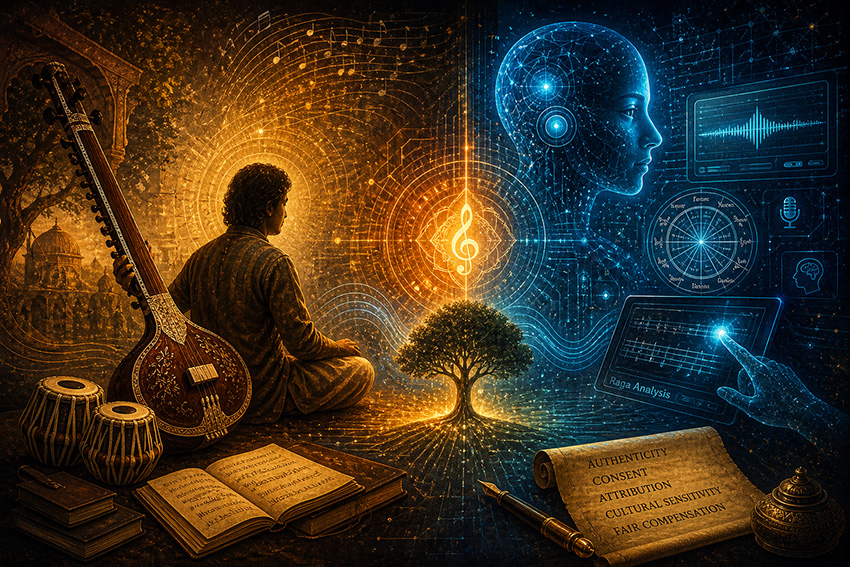
Artificial Intelligence has entered the world of music with remarkable speed.
Today, AI systems can generate melodies, imitate voices, assist in composition, and analyze musical structures with increasing precision. Across genres, these developments are being explored as tools of creativity and efficiency.
For Indian Classical Music, however, the conversation must be approached with greater nuance.
A raga is not merely a sequence of notes.
It is a disciplined system shaped by grammar, aesthetics, and centuries of lived tradition. Its expression depends on improvisation, contextual understanding, and the artist’s internalization of rasa.
AI, in its current form, operates differently.
It identifies patterns.
It learns from datasets.
It generates outputs based on probability.
This distinction is important.
AI can analyze a raga.
It can assist in identifying pitch, structure, or recurring phrases.
It can support students through feedback systems and learning tools.
In this sense, analytical AI offers significant possibilities — particularly in education, archiving, and documentation.
The complexity arises with generative AI.
When AI begins to create music “in the style of” a raga or an artist, questions of authenticity, ownership, and cultural interpretation emerge. Without carefully structured datasets, such outputs may reflect surface-level imitation rather than true grammatical depth.
More importantly, there are ethical concerns.
- Who owns the data used to train AI systems?
- Are artists’ recordings being used with consent?
- How should revenue be shared if AI-generated outputs draw from existing traditions?
- Can cultural forms be reduced to patterns without losing their philosophical essence?
These are not abstract questions.
They directly affect the future of artistic identity and cultural continuity.
This is where the need for ethical frameworks becomes essential.
Indian Classical Music requires datasets that are:
- Authenticated
- Contextually accurate
- Built with artist consent
- Designed with cultural sensitivity
Such datasets can enable AI systems to support, rather than distort, the tradition.
Equally important is the role of institutions and collective bodies.
Just as rights organizations emerged to manage performance and broadcasting royalties, the digital age may require new frameworks to govern AI usage, attribution, and compensation.
The goal is not to resist technology.
It is to ensure that innovation aligns with integrity.
AI has the potential to become a powerful ally — in pedagogy, preservation, and global dissemination. But without thoughtful design, it may also lead to oversimplification or misrepresentation.
Indian Classical Music has always balanced discipline with creativity, structure with freedom.
The AI era demands a similar balance — between technological advancement and cultural responsibility.
The future will not be defined by whether AI is used.
It will be defined by how consciously it is shaped.
In the final article of this series, we will explore how a culturally rooted and ethically governed Digital Ecosystem can be designed for the future of Indian Classical Music.
Read next article in the series : Designing an Ethical Digital Ecosystem for the Future of Indian Classical Music
Read previous article in the series : Algorithmic Gatekeepers: Power, Visibility, and Cultural Balance in the Digital Ecosystem