Walking into an Indian classical music concert for the first time can feel both exciting and slightly intimidating.
Should one clap after every improvisation? Is it acceptable to leave during a performance? Can photographs be taken? What happens when the artist sings or plays the same phrase repeatedly? And why do experienced listeners sometimes respond with a spontaneous “wah!” in the middle of a recital?
The good news is that Indian classical music does not demand prior expertise from its listeners. You do not need to recognise every raga, identify every tala or understand every technical nuance to enjoy a concert. Curiosity, attentiveness and respect are enough.
At the same time, a live classical music performance is a shared experience. The artist, accompanists, organisers and audience together create the atmosphere in which the music unfolds. A little awareness of concert etiquette can therefore help first-time listeners enjoy the performance more deeply while ensuring that others can do the same.
Arrive Before the Performance Begins
Reaching the venue early is one of the simplest ways to show respect for the artists and fellow listeners.
Indian classical concerts often begin with an alap, invocation or slow introduction that establishes the mood of the performance. Entering late can disturb not only the audience but also the concentration of the musicians.
Arriving 15 to 20 minutes early gives you enough time to:
- Find your seat without rushing
- Silence your phone
- Read the programme note
- Familiarise yourself with the artists
- Settle into the atmosphere of the venue
When delays are unavoidable, wait for an appropriate pause before entering, preferably with the guidance of an usher or organiser.
Keep Your Phone Silent—and Out of Sight
A ringtone during a quiet alap can interrupt an atmosphere that may have taken several minutes to build.
Phones should ideally be switched off or placed on silent mode before the concert begins. Vibration mode can also be distracting, particularly in intimate venues where even small sounds are audible.
Constantly checking messages, scrolling through social media or holding up a brightly lit screen can disturb people seated nearby. A live concert offers a rare opportunity to step away from digital distractions and listen with complete attention.
The music deserves your presence, not merely your attendance.
Do Not Record Without Permission
It may be tempting to capture a favourite composition or an impressive improvisation, but audio and video recording should not be assumed to be acceptable.
Artists may have concerns related to copyright, performance rights, artistic quality or the unauthorised circulation of incomplete recordings. Organisers may also have specific policies regarding photography and videography.
Before recording:
- Check the venue announcement
- Look for instructions in the programme
- Ask the organisers when uncertain
- Respect the artist’s stated preference
Even where photography is permitted, avoid flash and repeated camera movements. A concert should not become a competition to capture the best clip for social media.
Sometimes, the most meaningful way to preserve a performance is simply to listen.
Understand When to Applaud
One of the most common concerns for first-time listeners is knowing when to clap.
Unlike many Western classical concerts, Indian classical performances often welcome spontaneous appreciation. Listeners may applaud after a particularly imaginative improvisation, a complex rhythmic exchange, a powerful taan, an elegant tihai or a beautifully resolved musical phrase.
However, applause should arise naturally rather than mechanically.
It is usually appropriate to applaud:
- At the end of a composition
- After an especially striking improvisational passage
- Following a rhythmic climax
- At the conclusion of a solo exchange
- When the artist acknowledges the audience
If you are unsure, observe the more experienced listeners around you. There is no embarrassment in waiting for a clear conclusion before joining the applause.
“Wah!” is Welcome – But Timing Matters
Expressions such as “wah,” “kya baat hai” or “shabash” are part of the living culture of Indian classical performance.
When offered sincerely and at the right moment, they can encourage the artist and acknowledge a moment of beauty, imagination or technical brilliance. Many performers appreciate an alert and responsive audience.
But appreciation should not become a running commentary.
Repeated, loud or mistimed exclamations can distract the artists and other listeners. The purpose is to respond to the music, not to demonstrate one’s knowledge of it.
A thoughtful “wah” at the right moment often says more than several enthusiastic interruptions.
Avoid Talking During the Performance
Whispering may seem harmless, but sound travels easily in an auditorium, especially during softer passages.
Discussions about the raga, the artist, the composition or even the quality of the sound system should wait until the interval or the end of the concert.
This also applies to:
- Explaining the performance to a companion
- Predicting what the artist may perform next
- Identifying every raga aloud
- Discussing previous concerts
- Commenting on the artist’s technique
Knowledge enhances appreciation, but displaying that knowledge should never interfere with someone else’s listening experience.
Enter and Exit at Appropriate Moments
Indian classical performances often unfold without rigid breaks between every section. Walking in and out frequently can disturb the visual and emotional continuity of the recital.
When possible, enter or leave:
- Between two compositions
- During an announcement
- At the interval
- After the artist has clearly concluded a section
Avoid crossing directly in front of the stage during a performance. If you must leave urgently, do so quietly and with minimal disruption.
Those seated near aisles can also help by making space promptly rather than forcing others to struggle past in the middle of a delicate passage.
Be Mindful of Food, Packaging and Other Sounds
Opening a packet of chips during a slow and contemplative raga is unlikely to win the affection of fellow rasikas.
Avoid bringing noisy food into the auditorium. Crinkling wrappers, clinking bottles, chewing sounds and strong food aromas can be surprisingly intrusive.
Similarly, be mindful of:
- Repeated coughing without covering your mouth
- Moving chairs
- Dropping objects
- Jingling jewellery
- Tapping your feet loudly
- Rustling programmes continuously
Not every sound can be avoided, of course. The aim is not to sit in fear but to remain conscious of the shared listening environment.
Give the Accompanists Their Due
A classical concert is rarely the work of the principal artist alone.
Tabla players, mridangam artists, violinists, harmonium players, sarangi accompanists, flautists, tanpura artists and other musicians contribute significantly to the performance. Their sensitivity, anticipation and creative responses often shape the recital in profound ways.
First-time listeners should pay attention to the musical conversation happening on stage.
Notice how:
- The accompanist follows and supports the main artist
- Rhythmic ideas are exchanged
- A melodic phrase is echoed or developed
- The tempo gradually intensifies
- The artists communicate through gestures and eye contact
Applauding accompanists after a solo passage or meaningful exchange is an important acknowledgement of their artistry.
Do Not Compare Every Artist During the Concert
It is natural to have favourite musicians or to remember earlier interpretations of a raga. However, constantly comparing the performing artist with a legendary musician, a guru or a viral recording can prevent you from experiencing the concert on its own terms.
Every performance is shaped by the artist’s temperament, training, imagination and the mood of that particular evening.
Listen to what is being offered rather than only measuring it against what you already know.
Critical engagement is valuable. Premature judgement is not.
Allow the Music Time to Unfold
Indian classical music often develops gradually.
A raga may begin with a slow exploration before moving into composition, improvisation, rhythmic play and faster passages. For listeners accustomed to short-form digital content, this pace may initially feel unfamiliar.
Resist the urge to expect an immediate climax.
The opening minutes may be establishing:
- The personality of the raga
- Its important notes and phrases
- The emotional atmosphere
- The artist’s chosen approach
- The relationship between melody and rhythm
Listening patiently allows the architecture of the performance to reveal itself.
You Do Not Need to Understand Everything
First-time listeners sometimes worry that they are missing something because they cannot identify the raga or follow the tala.
Classical music can be appreciated at many levels.
One listener may focus on technical structure. Another may respond to emotion. Someone else may be drawn to the voice, instrument, poetry, rhythm or sheer energy of the performance.
You may begin simply by asking yourself:
- What mood does this music create?
- Which phrases remain in my mind?
- How does the tempo change?
- What is the interaction between the artists?
- How does the performance make me feel?
Technical understanding can grow over time. Emotional engagement can begin immediately.
Dress Comfortably and Appropriately
Most Indian classical concerts do not require highly formal clothing unless the invitation specifies otherwise.
Traditional attire is welcome, but not compulsory. The best choice is clothing that is respectful, comfortable and suitable for the venue.
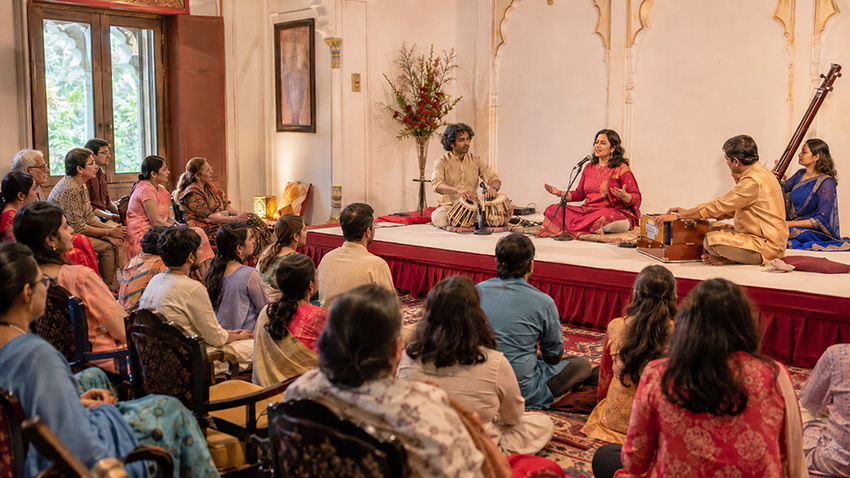
Avoid accessories or footwear that make repeated noise. In baithak-style concerts, where audiences may sit on the floor, choose clothing that allows you to sit comfortably for an extended period.
Be Considerate When Bringing Children
Introducing children to classical music is important for building future audiences. However, long concerts can be challenging for very young children.
Parents may consider:
- Choosing shorter or child-friendly performances
- Sitting near an exit
- Explaining basic etiquette beforehand
- Bringing the child after adequate rest and food
- Stepping outside if the child becomes restless
Children should not be discouraged from attending concerts merely because they are young. They should be introduced gradually, sensitively and without making the experience stressful for them or for others.
Stay for the Artist’s Acknowledgements
At the end of a recital, the artist may acknowledge the guru, accompanists, organisers, sponsors or audience. Leaving immediately after the final note can appear dismissive, particularly when the formal conclusion is still underway.
Whenever possible, remain seated until the announcement, vote of thanks or artist acknowledgement is complete.
The people behind the stage—including sound engineers, organisers, volunteers and venue teams—also contribute to the concert experience. Respecting the formal closure is one way of recognising their efforts.
Meet the Artist with Sensitivity
Audience members may wish to greet the artist after a concert, request a photograph or share their appreciation. Such interactions can be meaningful, but artists may also be physically and emotionally tired after performing.
Keep compliments sincere and brief. Avoid immediately offering unsolicited criticism, lengthy personal introductions or requests for free lessons, collaborations and recommendations.
A simple observation such as, “I particularly enjoyed the way the raga developed in the vilambit section,” is often more meaningful than a generic compliment.
When requesting a photograph, first ask politely.
Social Media Can Wait
Posting about a concert can help artists and organisers reach wider audiences. Tagging them, sharing thoughtful reflections and crediting accompanists are positive ways to support the classical arts.
However, social media engagement should not dominate the concert itself.
Instead of spending the recital editing videos, choosing filters and writing captions, experience the performance first. Share it later with accuracy and respect.
When posting:
- Spell artists’ names correctly
- Credit accompanists
- Mention the organiser and venue
- Avoid uploading long unauthorised recordings
- Do not circulate unflattering or intrusive backstage images
- Distinguish personal opinion from factual information
A responsible post can extend the life of a concert. A careless one can misrepresent it.
The Audience Is Part of the Performance
Indian classical music thrives on interaction.
Artists often respond to the energy, attentiveness and sensitivity of the audience. A deeply engaged hall can inspire a musician to take creative risks, extend an improvisation or explore a raga more expansively.
This does not mean that listeners must constantly react. Sometimes, complete silence is the most powerful form of appreciation.
The ideal audience is neither passive nor performative. It is present.
A Concert Is Not an Examination
There is no need to prove your knowledge, identify every composition or understand every rhythmic calculation.
Your first concert may leave you curious, confused, moved, surprised or eager to hear more. All of these are valid responses.
Begin with openness. Read about the artist beforehand. Listen without pressure. Ask questions after the performance. Attend different genres and musicians. Over time, the unfamiliar vocabulary and structures will begin to feel more accessible.
Every seasoned rasika was once a first-time listener.
A Shared Culture of Listening
Concert etiquette is not about enforcing rigid rules. It is about creating an environment in which music can be heard with attention and artists can perform without avoidable distractions.
Arrive on time. Keep your phone silent. Applaud sincerely. Appreciate accompanists. Avoid unnecessary movement and conversation. Most importantly, allow yourself to become absorbed in the music.
A classical concert asks for something increasingly rare in contemporary life: sustained attention.
In return, it offers the possibility of an experience that cannot be paused, replayed or reproduced in exactly the same way again.
What Have We Missed?
Concert traditions can vary across cities, venues, genres and gharanas. Experienced artists, organisers and rasikas may have encountered many other examples of good—or not-so-good—audience behaviour.
Is there an important rule of concert etiquette that we have overlooked? Is there a practice that needs to change with the times? Have you witnessed an incident that offers a useful lesson for audiences?
Share your suggestions and experiences with us. The most thoughtful responses may help us expand this guide and build a more attentive, welcoming and informed concert culture.
Artists are among the most influential guides in shaping an informed and sensitive audience. We invite musicians, dancers, accompanists, gurus, organisers and cultural institutions to share this article with their students and followers. A better-informed audience not only enhances the concert experience but also feels more confident about entering classical performance spaces. By sharing these simple guidelines, you can help nurture attentive rasikas, encourage more people to attend live concerts and strengthen the relationship between artists and audiences.