


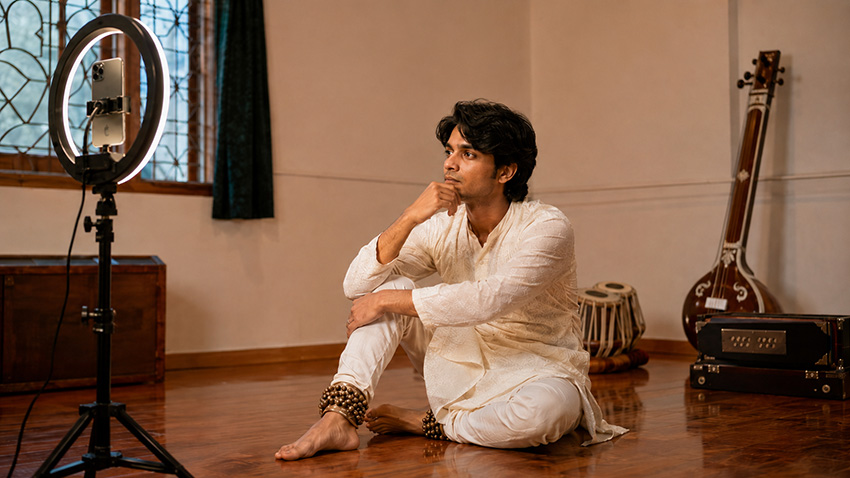
A young classical musician may spend years refining a bandish. A dancer may rehearse an abhinaya sequence countless times before presenting it on stage. Yet, when the same artist enters the world of Instagram, YouTube or Facebook, the rules seem very different.
Classical music training values patience, discipline and depth. Social media rewards speed, visibility and constant engagement.
This often creates confusion.
Should every rehearsal become a reel? Should artists follow every trend? Is frequent posting necessary? And how can one promote serious artistic work without reducing it to content?
Social media can help young artists reach wider audiences, connect with organisers, attract students, document their journey and build a professional identity. But it can also encourage exaggeration, poor presentation and unhealthy comparison.
The challenge is not whether young classical artists should use social media. The challenge is how to use it without allowing the platform to overpower the art.
Here are 20 common mistakes young artists should avoid.
1. Waiting to Be Discovered
Many talented artists assume that good work will eventually attract recognition on its own.
But organisers cannot invite an artist they have never encountered. Audiences cannot attend a concert they do not know about. Publications cannot feature work that is difficult to access.
A professional profile should clearly mention the artist’s discipline, guru, location, selected experience, contact details and links to representative work.
Visibility is not vanity. It is discoverability.
2. Promoting More Than Practicing
This is perhaps the most serious mistake.
Recording, editing, posting and checking engagement can gradually consume the time meant for riyaz. Practice becomes content creation, and the artist begins to ask what will look good online rather than what needs artistic improvement.
A polished profile may attract attention, but only strong technique, repertoire and stage maturity can sustain it.
Promotion should support the art, not replace it.
3. Having No Clear Artistic Identity
Some profiles feel like random collections of performance clips, travel photographs, motivational quotes, festival greetings and trends.
Personality is welcome, but visitors should still understand what the artist practices, what repertoire interests them and what makes their journey distinctive.
A vocalist may share rare compositions. A dancer may explore literature behind abhinaya. A percussionist may explain rhythmic concepts.
Clarity makes an artist memorable.
4. Posting Only Event Posters
A page filled entirely with posters rarely builds engagement.
Posters inform, but they do not always create interest. Audiences also want to know why the performance matters and what they can expect.
Along with a poster, artists can share a rehearsal glimpse, the inspiration behind the work, the chosen repertoire, an introduction to accompanists or a brief personal invitation.
Promotion should create curiosity, not merely announce dates.
5. Uploading Poor-Quality Videos
Good art can appear weak when recorded badly.
Distorted audio, shaky framing, poor lighting and distracting backgrounds reduce the impact of serious work.
For musicians, balanced sound is essential. For dancers, the full body and performance space should remain visible.
Before posting, check the audio, framing, lighting, background and beginning and end of the clip.
A short, well-recorded excerpt is better than a long, poorly presented video.
6. Posting Every Available Clip
Not every recording needs to be shared.
Artists often upload multiple clips from the same event, including sections with weak sound, visible mistakes or distracting audience movement.
Curation is a professional skill.
Before uploading, ask whether the clip represents your present standard, adds something new and is technically acceptable.
A carefully selected portfolio is stronger than a digital dump.
7. Following Every Trend
Trends can increase reach, but not every viral format suits classical work.
Using a trending sound over a serious performance or forcing a traditional composition into an unrelated comic template may attract views but weaken artistic identity.
A trend is useful only when it helps explain, contextualise or introduce the art without distorting it.
Do not ask only, “Will this get views?”
Ask, “Does this serve the work?”
8. Confusing Followers with Audiences
A high follower count does not necessarily lead to concert attendance, credibility or meaningful opportunities.
A smaller community that watches, attends, responds and recommends the artist may be more valuable than thousands of passive followers.
Look beyond likes. Ask whether people are watching the complete clip, attending performances, making enquiries and returning to the page.
Followers are numbers. Audiences build relationships.
9. Using Inflated Language
Every concert need not be “prestigious.” Every invitation need not be “historic.” Every certificate need not be described as an “honour.”
Excessive adjectives can make genuine achievements appear less credible.
Instead of writing, “Honoured to perform at the most prestigious platform,” say, “Grateful for the opportunity to present my work at…”
Facts create trust. Exaggeration creates doubt.
10. Treating Every Achievement as a Milestone
First performances, important awards and major collaborations deserve celebration. But every rehearsal, certificate, backstage photograph or minor mention need not be presented as career-defining.
Smaller moments can be shared honestly as learning experiences, collaborations or meaningful steps in the journey.
Measured communication makes genuine milestones more powerful.
11. Forgetting to Credit Accompanists
Classical performance is rarely an individual achievement.
A vocalist, dancer or instrumentalist may depend on accompanists, composers, choreographers, technicians, photographers and organisers.
Posts should credit all relevant collaborators accurately.
Acknowledging others does not diminish the principal artist. It reflects confidence and professional ethics.
12. Ignoring the Guru and Lineage
Some artists mention their guru prominently at the beginning of their career but gradually reduce that acknowledgement as visibility grows.
Training lineage is not merely a promotional credential. It represents guidance, discipline and artistic inheritance.
Acknowledgement should be sincere and appropriate—not ceremonial or convenient.
Respect for the guru is reflected in both words and conduct.
13. Tagging People Irrelevantly
Tagging dozens of senior artists, institutions, journalists and organisers in every post can appear intrusive.
Tag someone only when they are part of the event, directly connected with the content or genuinely being acknowledged.
Thoughtful tagging builds relationships.
Random tagging creates noise.
14. Sending Unsolicited Links Repeatedly
Repeatedly forwarding videos through direct messages can quickly become irritating.
A relevant and courteous message is more effective than sending a bare link with “Please watch and support.”
Introduce yourself briefly, explain why the content may be relevant and share only one or two strong links.
Professional outreach should be selective, not relentless.
15. Becoming Active Only Around Events
Some artists post frequently before a performance and disappear immediately afterwards.
This makes the profile feel transactional.
Between events, artists can share insights into repertoire, reflections on practice, poetry behind compositions, lessons from senior artists or challenges encountered during preparation.
Audiences are interested not only in the final performance but also in the process behind it.
16. Posting Inconsistently
Uploading ten posts in one week and then disappearing for three months does not build continuity.
Consistency does not mean posting daily. It means maintaining a realistic rhythm.
One meaningful clip a week or one thoughtful post every fortnight may be enough.
A sustainable pattern is better than bursts of activity followed by silence.
17. Keeping the Profile Unclear
A profile should immediately tell visitors who the artist is.
Common omissions include:
- No art form mentioned
- No guru or training information
- No location
- No contact details
- Broken links
- Outdated biography
- No representative pinned post
A simple and clear profile appears more professional than an elaborate but confusing one.
18. Posting Without Context
A beautiful clip may still leave viewers uncertain about what they are watching.
A short caption can mention the raga, tala, composition, poet, choreography, occasion or accompanists.
Context does not require a long academic explanation. Even two thoughtful lines can help audiences understand and remember the work.
Context turns scrolling into engagement.
19. Measuring Self-Worth Through Likes
A carefully prepared classical clip may receive fewer views than a casual trend. That does not mean the classical work has less value.
Algorithms do not measure discipline, originality or artistic depth.
Artists should study engagement intelligently but not emotionally. Low views may indicate weak timing, poor presentation or limited reach—not weak art.
Self-worth must remain rooted in practice, learning and honest feedback.
20. Forgetting That the Internet Remembers
Careless comments, public arguments, exaggerated claims and disrespectful criticism can remain visible for years.
Before posting, ask:
- Is this accurate?
- Is it respectful?
- Could it be misunderstood?
- Would I be comfortable if my guru or a future organiser saw it?
- Does this reflect the professional identity I want to build?
Digital conduct is now part of professional conduct.
Social Media Is a Stage – But Not the Only Stage
Social media can help a young artist reach thousands of people. It can support audience development, learning and collaboration.
But it can also become a distraction if every artistic decision is made for visibility.
A strong profile should not merely say, “Look at me.”
It should communicate:
- This is what I am learning.
- This is what I am exploring.
- These are the people who shaped me.
- This is the tradition I belong to.
- This is the work I wish to share.
Promotion becomes meaningful when it leads audiences towards the art.
From Riyaz to Reels—with Balance
Young artists do not need to reject social media in order to protect artistic integrity. Nor do they need to become full-time content creators in order to remain relevant.
They need balance.
Riyaz builds the artist. Reels may help people discover the artist. One cannot substitute for the other.
The strongest digital presence is rooted in real artistic work, honest communication, thoughtful curation and respect for everyone involved in the creative process.
The goal should not be to appear constantly visible.
The goal should be to become genuinely worth discovering.






One Response
Here’s a constructive comment that adds a fresh perspective without repeating the article’s points:
A valuable addition to this discussion would be the importance of building meaningful relationships within the artistic community, not just an online audience. Collaborating with fellow artists, engaging with mentors, and supporting peers can create opportunities that algorithms never will. Social media trends change constantly, but genuine professional networks and goodwill often have a far more lasting impact on an artist’s growth, learning, and career sustainability.