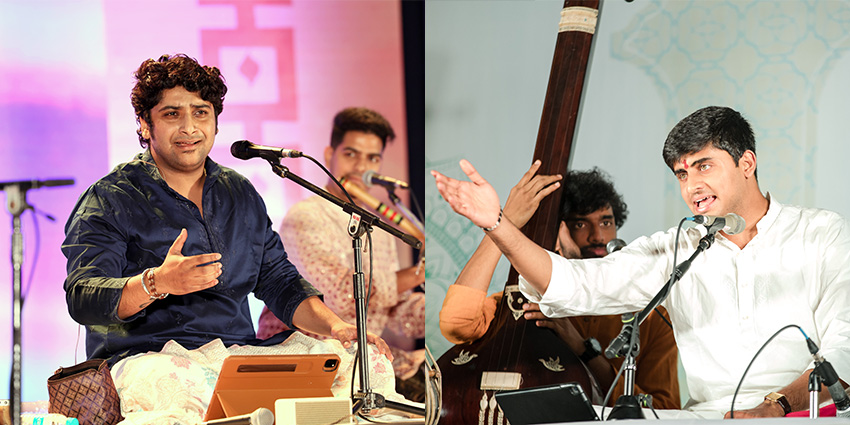
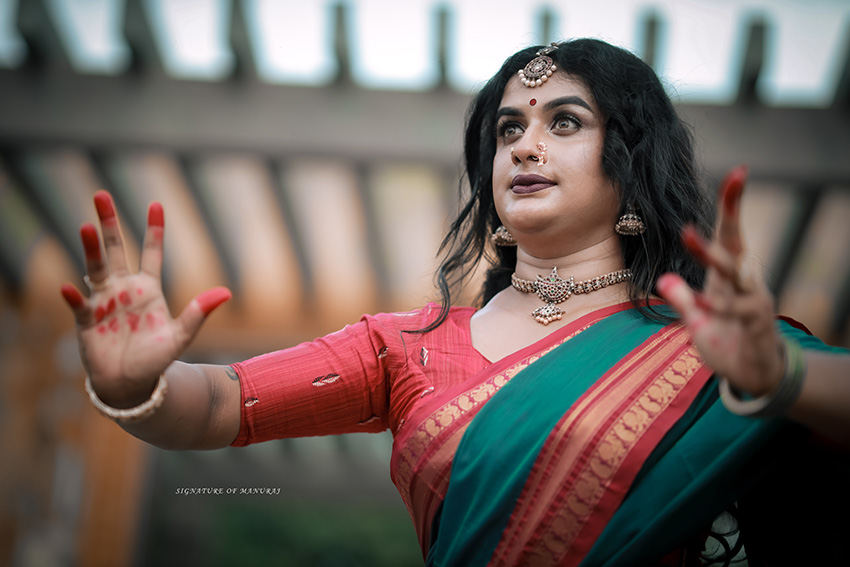
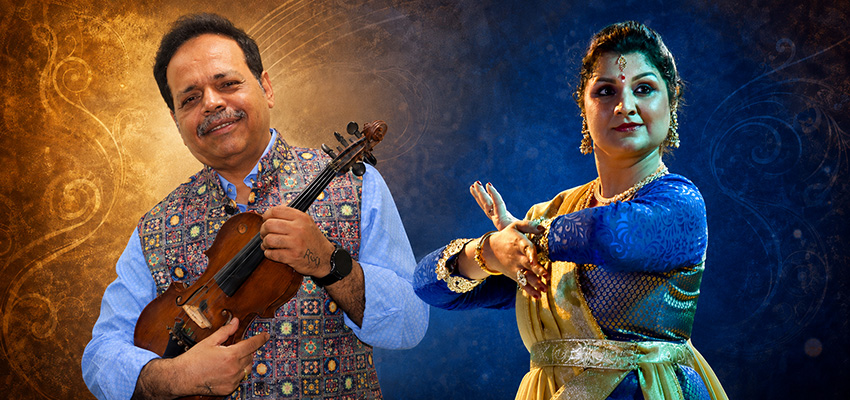
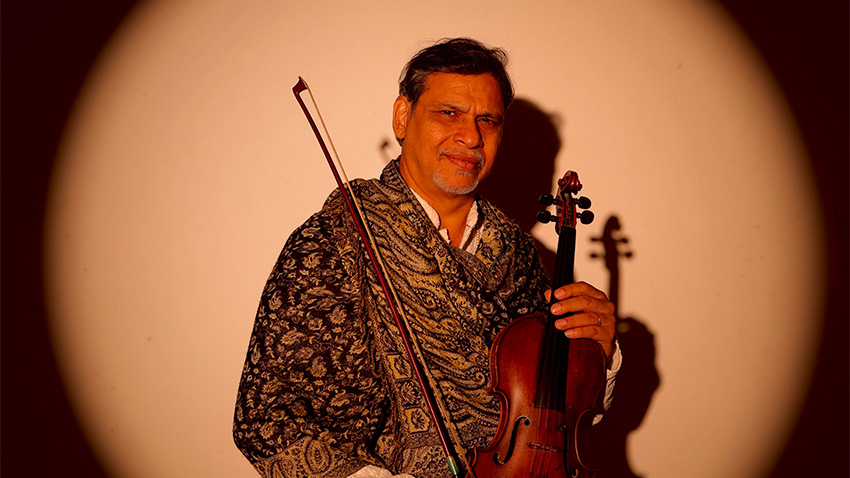
On the evening of 12 May 2026, the Stein Auditorium at India Habitat Centre transformed into a meditative landscape of myth, memory, longing, and fractured humanity. Presented by Nirvana Arts Foundation, internationally acclaimed Kathak exponent Sudip Chakraborty unveiled The Blue God, a dance-theatre production that journeyed far beyond the familiar terrain of Radha-Krishna romanticism. Beside him stood Kolkata-based vocalist and theatre musician Jaydeep Sinha, whose resonant voice became the emotional pulse of the evening.
The Blue God did not unfold as a conventional narrative. Instead, it emerged like fragments of consciousness from Krishna’s vast symbolic universe — shifting identities, dissolving boundaries, and archetypes mirroring human psychology. Sudip Chakraborty did not simply perform mythological figures; he inhabited emotional landscapes. Through Kathak vocabulary, theatrical stillness, intricate footwork, and layered abhinaya, he explored envy, surrender, motherhood, loneliness, dependency, and the anguish of becoming a commodity within structures of power.
The production moved through striking manifestations — Putna, Bansuri, Draupadi, and finally Radha. Each carried its own emotional climate while remaining bound to Krishna, the eternal blue presence around whom devotion, violence, desire, and destruction revolve.
Among the evening’s most unforgettable passages was the portrayal of Putna. In mythology, she is remembered as the demoness sent to poison the infant Krishna. Yet Sudip approached her not as evil incarnate, but as a deeply fractured woman carrying tenderness within terror. His movement language altered perceptibly: the torso softened, wrists curved inward with maternal delicacy, and the gat-bhav unfolded with cinematic intimacy. When Putna cradled Krishna and breastfed him with unsettling affection, Sudip’s expressions revealed a haunting blend of nurture and doom.
Then came the rupture. As Krishna metaphorically consumed not only the poisoned milk but Putna’s very life force, the performer’s face transformed from maternal surrender into unbearable agony. The transition was swift, visceral, and devastating.
Here, Jaydeep Sinha’s contribution became indispensable. His expansive alaaps and dramatic tonal shifts created an atmosphere thick with sorrow. The padhant intensified the emotional fracture while the rhythmic architecture tightened around the scene like a noose. Voice, rhythm, and movement ceased to exist as separate disciplines; together they formed a single breathing organism of pain.
Equally consuming was the Draupadi sequence, arguably the emotional summit of the evening. Sudip’s transitions between the male figures of the Mahabharata court were executed with chilling precision. In seconds, his face shifted from arrogance to greed, from drunken amusement to predatory entitlement. Draupadi emerged not merely as a mythological victim, but as a symbol of every woman reduced to a negotiable object within patriarchal structures.
The gambling court became a terrifying theatre of masculine chauvinism. Through sharp chakkars, angular stances, and abrupt rhythmic breaks, Sudip exposed the moral collapse of men willing to gamble away a woman to satisfy ambition and ego. His eyes flashed with cruelty in one instant and transformed into Draupadi’s helpless terror in the next. The echo of the Kaurava court’s laughter seemed to reverberate through his constantly shifting expressions.
Behind this, thunderous pakhawaj patterns recreated the brutality of the epic moment with startling immediacy. Audience members found themselves transported into collective cultural memory, recalling the enduring emotional power of the Mahabharata narrative. Jaydeep’s commanding vocal strokes intensified the atmosphere, while the feverish resonance of Sudip’s ghungroos seemed to draw spectators into another realm altogether — one where mythology no longer felt distant, but frighteningly contemporary.
The concluding act of Radha arrived not as romance, but as residue — the loneliness that remains after divine love has passed through the body. Radha here became memory itself: abandoned, wounded, yet illuminated. Sudip’s restrained abhinaya in this final segment displayed exceptional maturity, allowing silence and stillness to communicate as profoundly as rhythm.
What makes The Blue God particularly significant is its refusal to imprison Krishna within decorative devotionalism. Instead, Krishna emerged as a catalyst through whom human contradictions surfaced. The production functioned less as mythology retold and more as mythology interrogated.
A major force behind the production’s emotional depth was undoubtedly Jaydeep Sinha. Trained in Hindustani classical music from childhood under gurus including Dr. Samiran Chattopadhyay, and later nurtured in Rabindrasangeet under the legendary Maya Sen, Jaydeep has consistently resisted confinement within a single musical identity. His artistic journey moves fluidly across Hindustani classical music, Rabindrasangeet, ghazal, theatre music, and dance accompaniment.
Winning the All India Radio Music Competition in Ghazal singing in 2009 brought him national recognition, but his artistic curiosity continued expanding across languages, forms, and geographies. His immersion in Urdu literature and diction enriched his ghazal gayaki with poetic sensitivity, allowing his performances to carry not merely musical sophistication but emotional intelligence.
From performances in the United Kingdom, Bangladesh, Poland, Denmark, Peru, and Malaysia to collaborations across Indian theatre circuits, Jaydeep has evolved into one of the rare contemporary vocalists capable of inhabiting theatrical space with remarkable instinct and dramatic nuance.
For over a decade, he has remained deeply associated with theatre music, contributing to acclaimed productions such as Urubhangam, Macbeth Badya, Sitayan, Ghoramukho Pala, and Uronto Tarader Chhaya. His collaborations with dancers and gurus across Kathak and Odissi traditions reflect both versatility and trust earned through years of rigorous artistic discipline. Whether accompanying stalwarts like Saswati Sen, Shila Mehta, Rani Khanam, Rajendra Gangani, and Durga Arya, or composing for award-winning theatre productions, Jaydeep has cultivated a rare balance between scholarship and instinct.
Sudip Chakraborty, meanwhile, continues to emerge as one of the most compelling contemporary voices in Kathak dance-theatre. Rooted in the Lucknow and Jaipur gharanas yet unafraid to experiment with literature, psychological theatre, and modern dramaturgy, he has steadily expanded Kathak’s visual and emotional vocabulary.
Trained under gurus including Pranab Sanyal, Sandip Mallick, and Pandit Jai Kishan Maharaj, Sudip’s artistic language combines classical rigour with radical theatrical imagination. His body of work — from Out, Damned Spot! inspired by Shakespeare’s Macbeth to productions like Sharira, Besotted, and Echoes of Narciss-Us — reveals an artist deeply invested in exploring the human psyche through movement. In The Blue God, this exploration reached one of its most emotionally sophisticated forms.
The artistic chemistry between Sudip and Jaydeep has deepened steadily over years of collaboration. Only days before this performance, the duo had mesmerised audiences at Triveni with their dance-theatrical interpretation of Macbeth. They have also explored Tagore’s love songs in Hindi adaptation, building bridges between literary and performative traditions with remarkable sensitivity.
The evening received warm appreciation from eminent Kathak exponent Shovana Narayan and noted dance critic Leela Venkataraman, both of whom acknowledged Sudip’s nuanced expressions, theatrical command, and inventive Kathak technique.
As the final echoes of ghungroos dissolved into silence, The Blue God lingered not merely as a performance, but as an emotional afterimage. It reminded the audience that mythology survives because human wounds survive — love, humiliation, longing, violence, surrender, and transcendence endlessly repeating themselves across centuries in changing disguises.
One can only hope this remarkable duo continues to return with newer shades of performance and deeper interrogations of myth and memory. Until then, audiences will wait eagerly for their next journey into the luminous unknown.
About the Writer: Aseem Asha Usman is a Delhi-based independent arts writer, poet, and trained documentary filmmaker.